Premiere: Rambadu & Rosillon - α 05h 40m 45.5s δ –01° 56′ 34″ [R006]
At the peak of summer I am back with another premiere and a captivating story about the two artists behind the music. This one holds a special place. It is not the first time I sit down with both of them to create a feature. Rosillon and Rambadu are familiar faces in the Nachtblumen world as both have appeared on the platform with a podcast and an in-depth editorial feature, and in recent years I have had the privilege of following their artistic journeys from close by.
What brought us back together was their forthcoming collaborative EP “α δ”, set to release on Rambadu’s label on the 24th of July and with it, a natural opportunity to look back on the time since our last conversations in 2021 and 2022. What happened on both an artistic and personal level, how their processes developed, stories from the studio and more.
I met Rosillon in the summer of 2020 and we have been sharing life together ever since, currently living in Rotterdam. Our lives have always been deeply entangled with music long before we met, and naturally music being a strong mutual passion and connection, we started to also work together. Learning from each other, sharing experiences and figuring out new territories together has been so rewarding, but one of the things I find particularly fascinating has been witnessing the process of how one becomes an artist. The thinking, dedication, discipline, passion, struggle and everything that comes with being a creator. I speak to many artists and I have always loved the insights they share about their journeys, but when you live with someone and you see the daily work, it is something else entirely. I am glad to have Rosillon back on the platform with his debut as a producer.
Meeting Rambadu happened naturally through Rosillon in 2021, shortly before I relocated to Rotterdam from Berlin, and we connected right away. When we did our first in-depth feature together, it was also in a way the early days of his career as a DJ and producer. The past five years have been very eventful for Rambadu - from multiple releases on Hypnus Records to building his own label, creating a live set, touring the world and growing as an artist every day. I always love the opportunity to reconnect with artists in an interview context, because it gives us a chance to see where our interests and values stand now compared to back then and what happened to our hopes and dreams.
Today’s format is a little different than usual, because the experience itself was different too. I had very few questions prepared, and as soon as I gave them the first one, Rambadu and Rosillon turned to each other and the conversation took on a life of its own. You will still hear me here and there, but what you are about to read is largely theirs. Two artists reflecting on their collaboration in real time, the way they actually talk to each other. It’s time to get down to the core of it, from the first encounter between two young artists to making a record together.
The Story of Rambadu and Rosillon: From a Discovery at Clone to Years of Collaboration and Making a Record Together
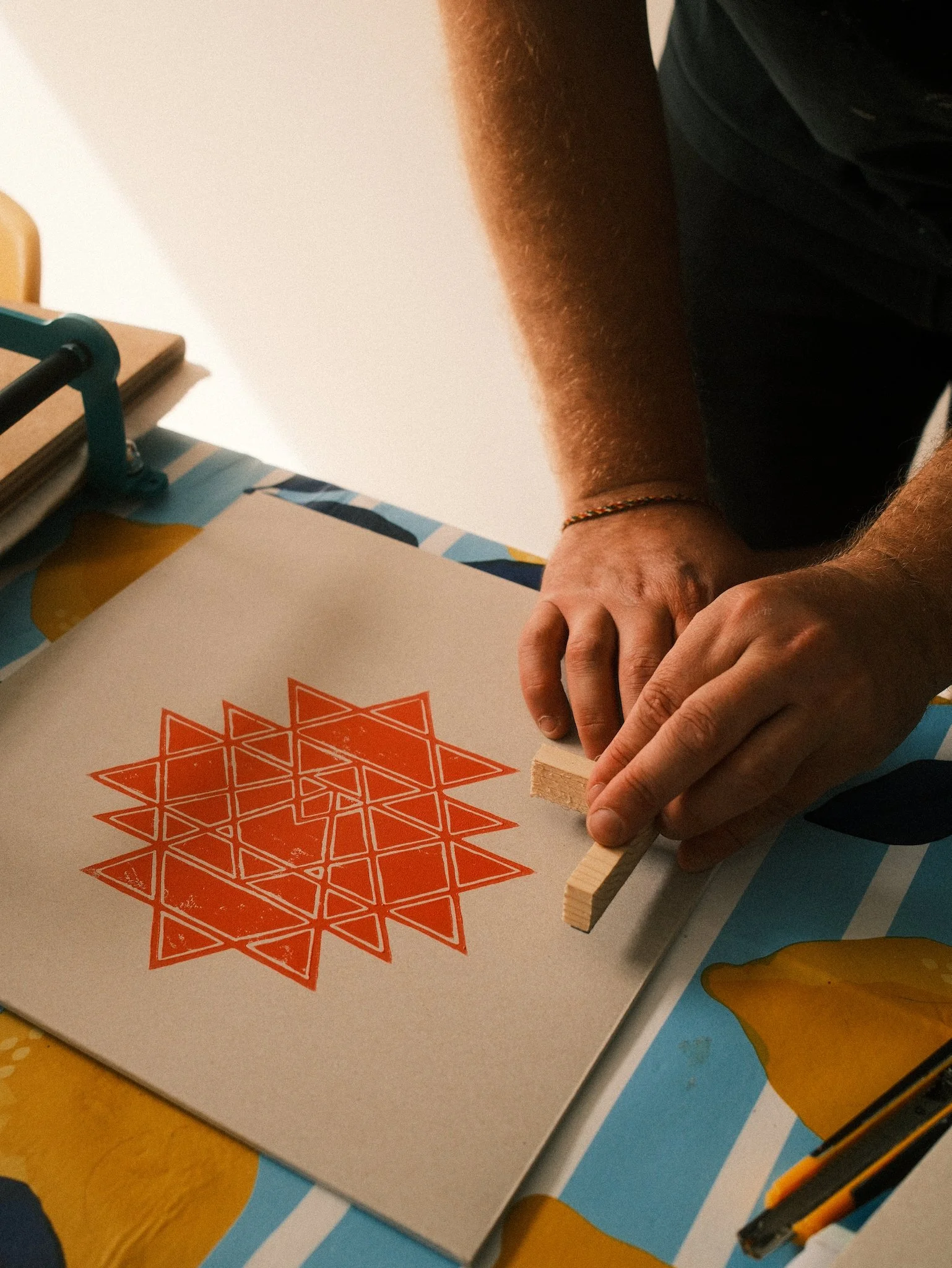
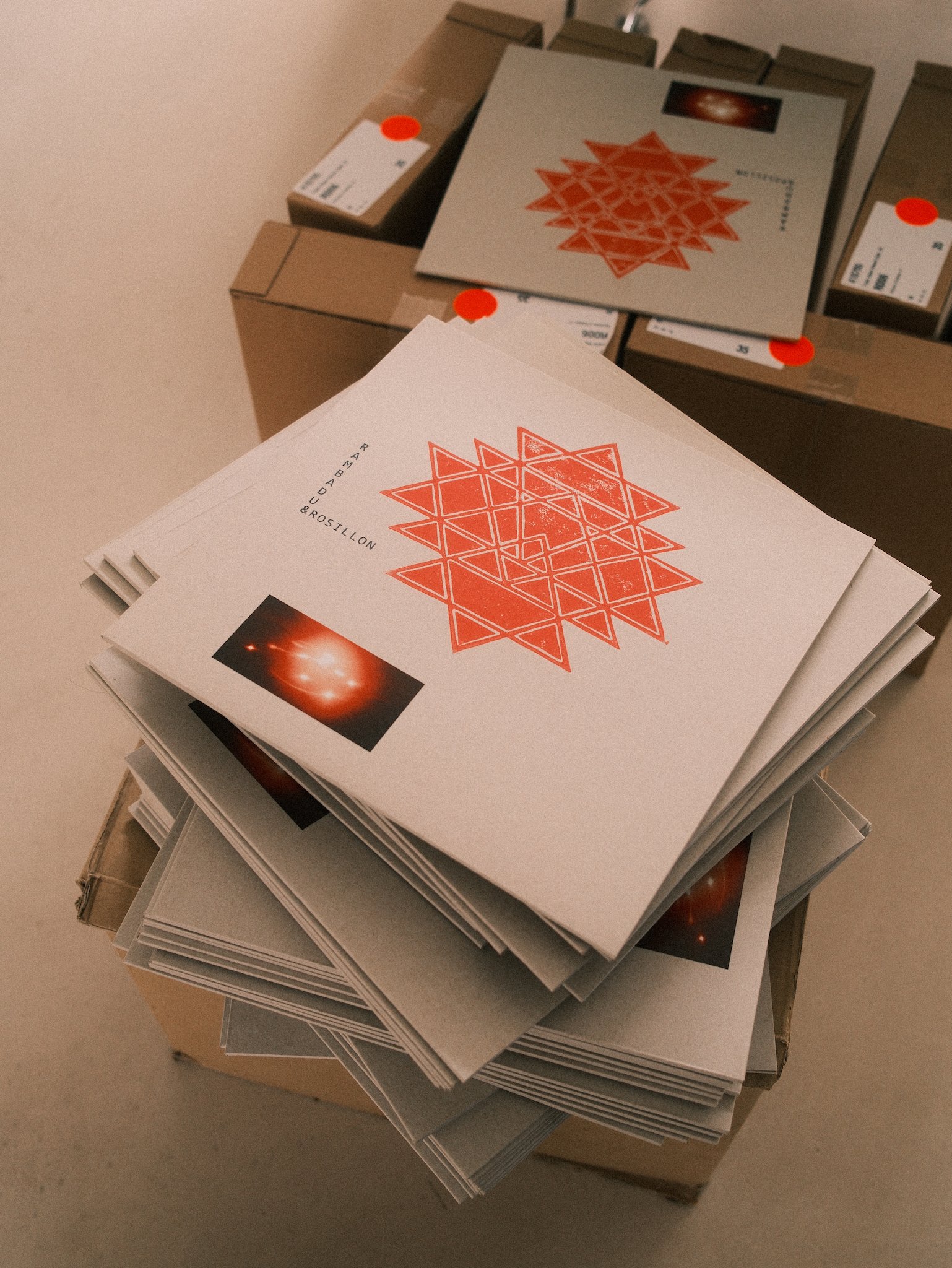
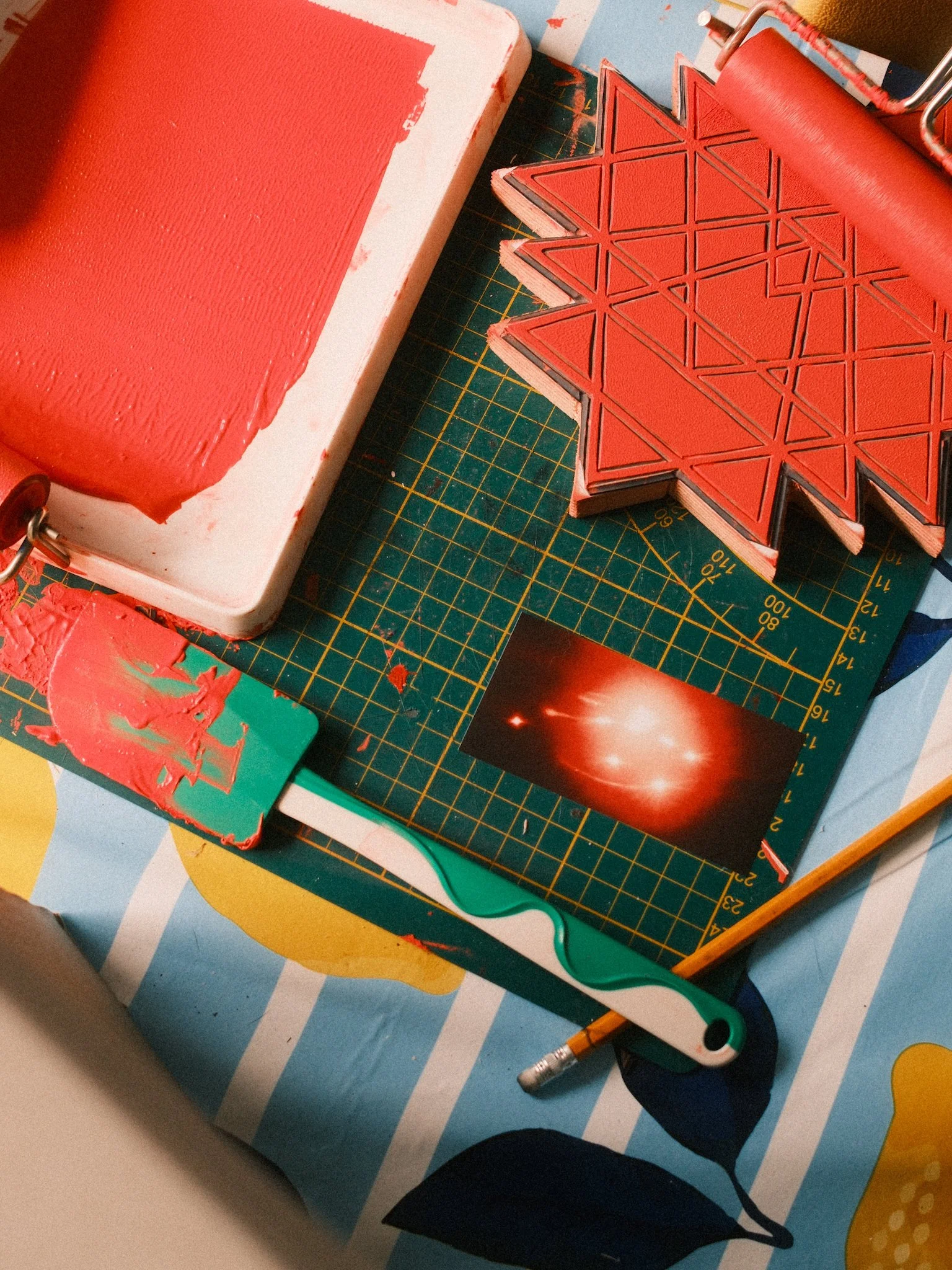
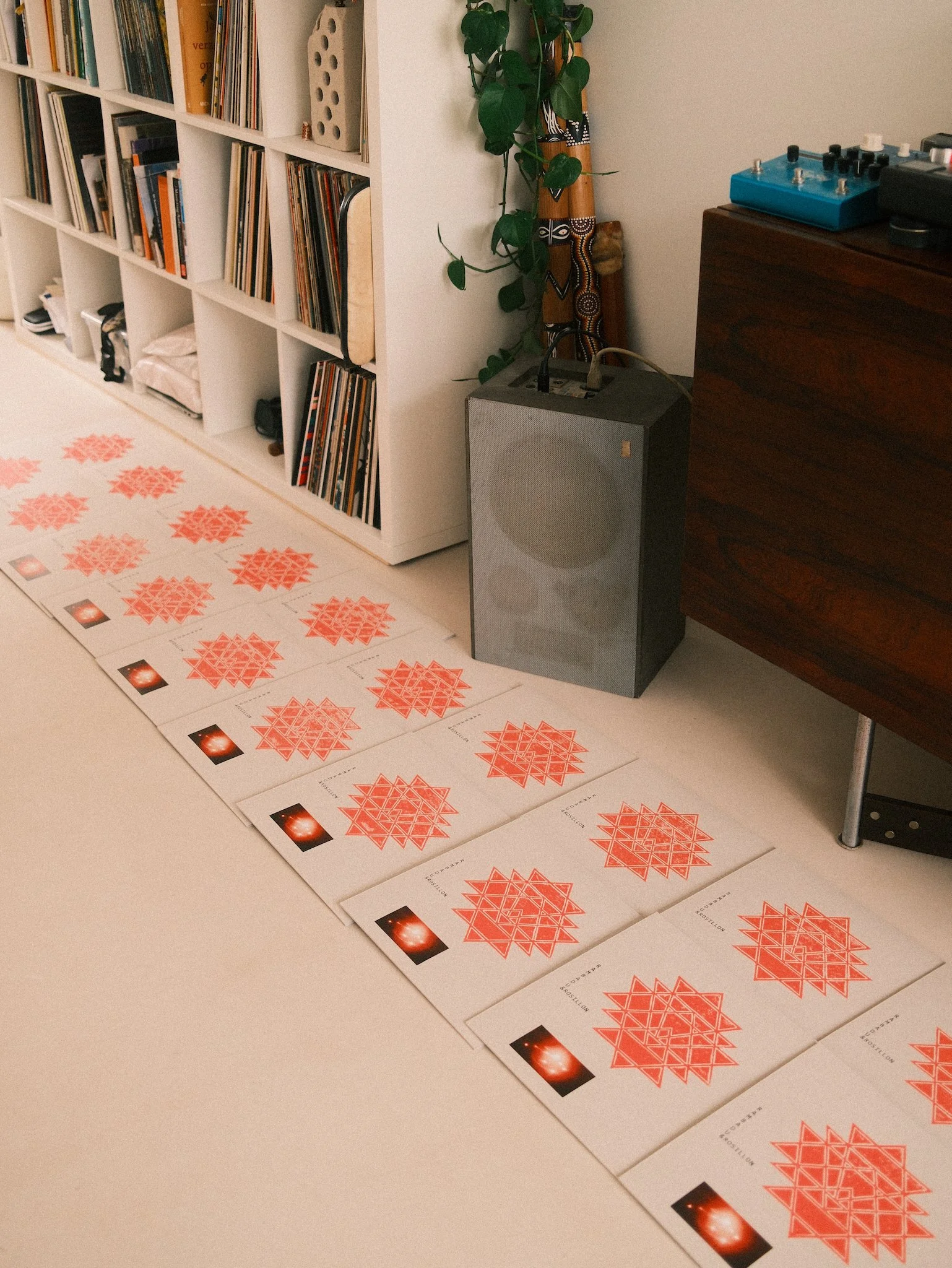
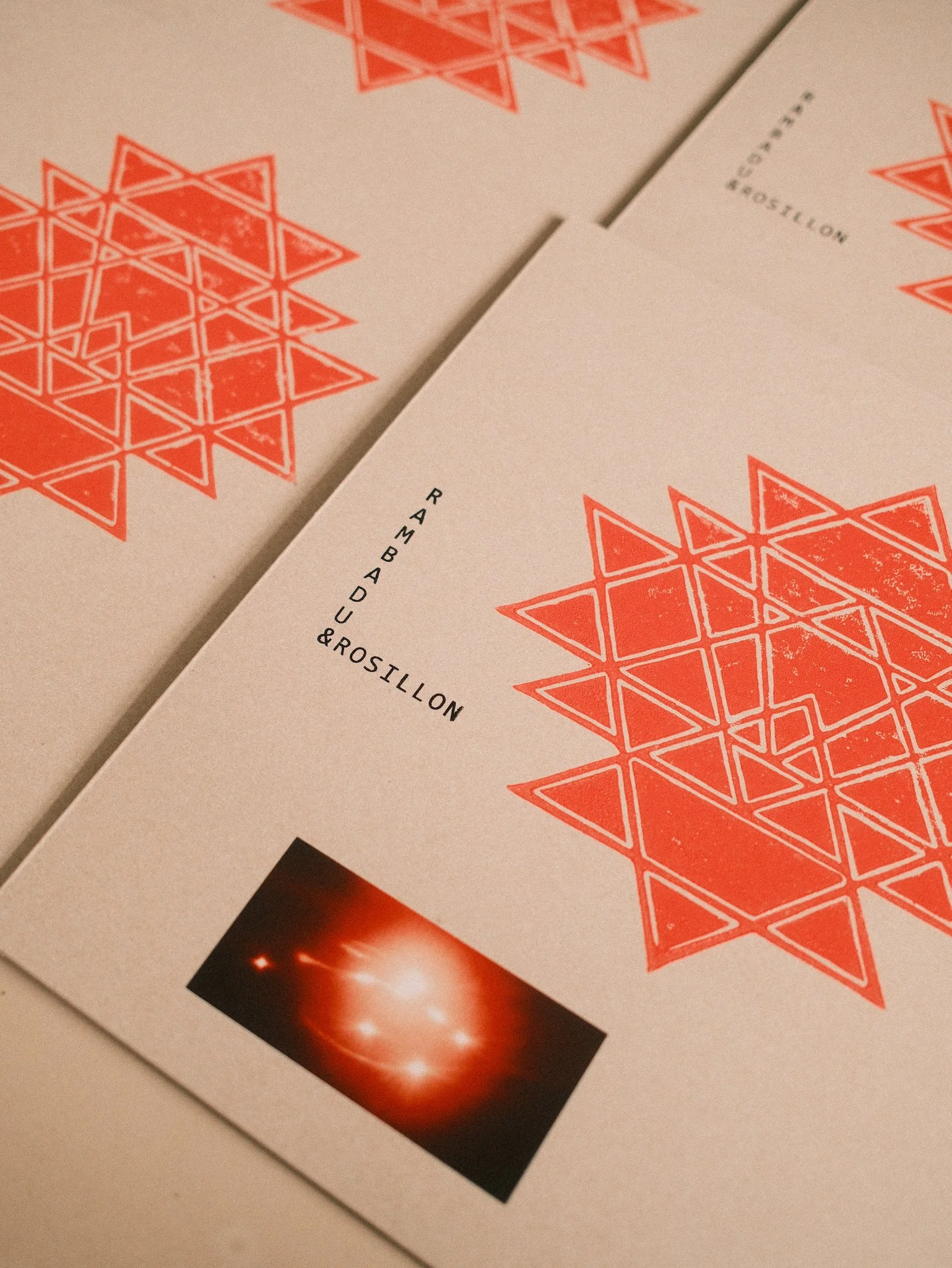
It is a sunny afternoon in Rotterdam. Paul has brought incense back from Nepal for Rosillon, there are cherries on the table, and spread across it too are the printed stickers and stamp for “α δ”, which they hold up and arrange together, figuring out the composition of the record cover. The conversation starts before the interview does. This is the kind of afternoon that only happens between friends who have built something real together over time and today, that something is a record. Rosillon starts from the beginning, sharing his first memories of Rambadu:
Rosillon: “I remember I saw the second release of his label at Clone, and then someone came to me saying, ‘It’s actually someone who lives in Rotterdam.’ We were doing the Operator residency with Embodiment at that time, and each resident had to invite someone, and I thought, ‘Okay, wow it’s like a sign that this person lives in Rotterdam, let’s connect. When I first reached out, you mentioned that a UK platform had invited you to record a mix, but that the project never materialized. You then said, ‘Well, this sounds fun, let’s do it!’ As it turned out, this became your first DJ out output as Rambadu.’’
Paul smiles and nods: “Yes, that’s right.”
I am momentarily struck by a warm feeling from the realization of how many milestones these two have been a part of in each other’s careers, and how fast time has moved since those firsts. Before we dive deeper into the release and into the music, I want to know how both have been doing since we last spoke.
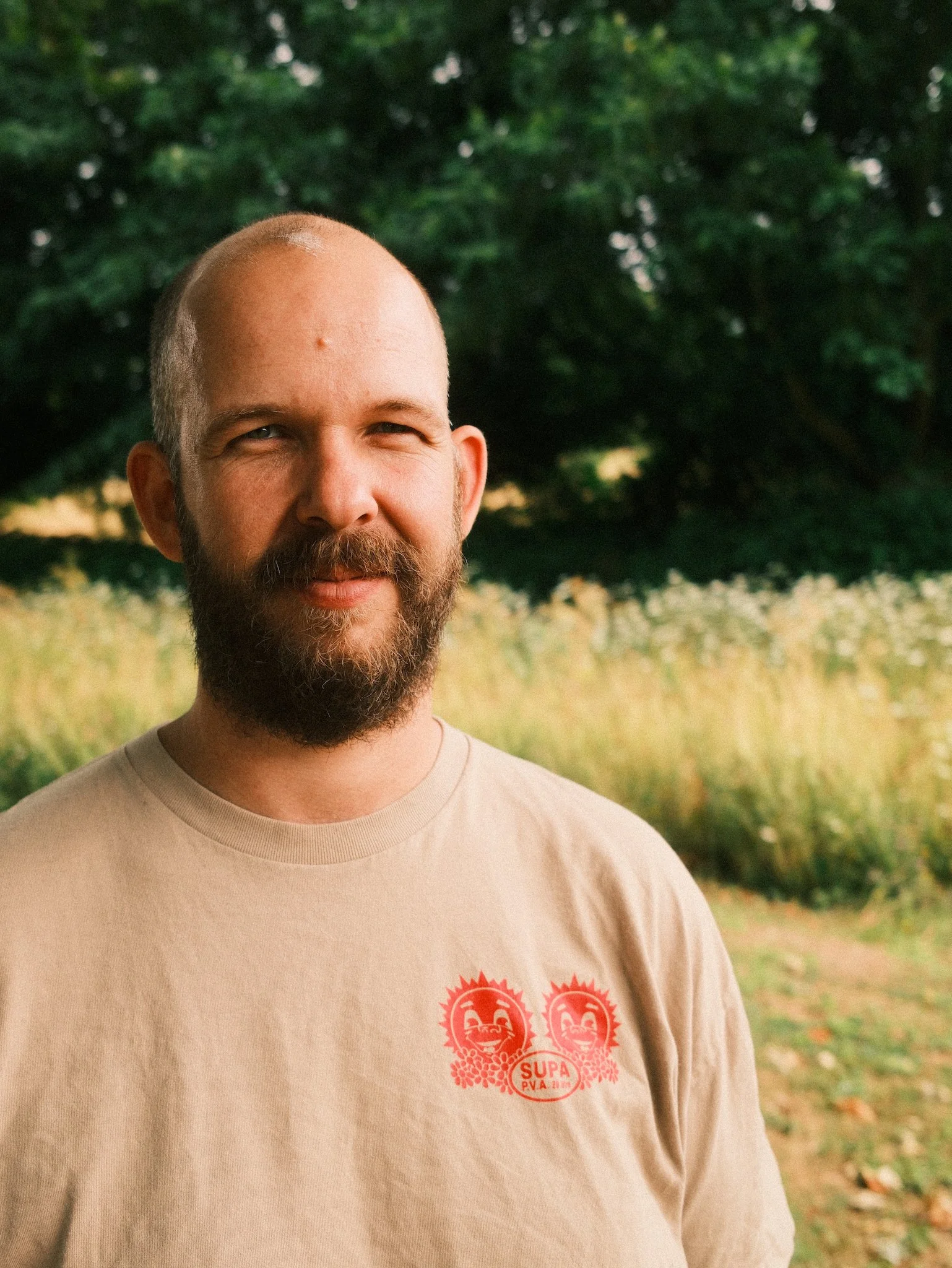
Rambadu
Rambadu: “All over, physically and mentally. So much has happened almost too much to comprehend, in a way. It’s been a real evolution. It has kind of exploded. The personal evolution of the music-making process keeps changing, and playing live now is a big influence on my production as well. The two things go hand in hand, because it speeds up the process to be able to use sketches in the live sets. The label is doing pretty solid, but the job gets bigger too. Moving houses, having a baby, everything makes you realise that time is very limited. At the start I had more free time to do everything, including the stamping and the visual side of the label, which I love, but it’s also like ‘Oh my god, next month I have to stamp 300 records.’ It’s not that big an effort, but you have to plan it. This is the day that needs to be finished, so I need to start now.” He laughs and adds: “The mission isn’t stopping, it keeps going.”
The evergreen warm and cheerful spirit of Rambadu, being always with a smile is something you really have to experience in person. Time management is one of the realities of being an independent artist today, a life where passion for music has to coexist with everything else, including, more often than not, a “main job” to finance it all. The past few years have seen Rambadu fully establish himself as one of the more distinctive voices in his corner of electronic music - an artist with a sound and vision that is authentic, pure and entirely his own. On his own label he has continued to build a catalogue of carefully chosen releases. A collaboration with Claudio PRC, his solo release En Viron, and a growing body of work that reflects the values and sound he has believed in from the start. Moreover, the artist released ‘Energy Systems’ on Hypnus Records, his debut album consisting of seven tracks shared under the December full moon of 2025, and the kind of milestone that marks a genuine arrival in an artist’s journey. Alongside that, a live set has been in development and out in the world, taking his music into new physical territory and feeding directly back into the studio work he describes.
I turn to Rosillon for an update. So far known as the co-founder of Embodiment and as a vinyl-only DJ, today Rosillon debuts in a new way, one he has been working towards since the very beginning six years ago.
Rosillon: “For me it’s actually quite nice to reflect on this. I remember that after we met at Operator, you said, 'Let me know if you ever want to come by the studio to jam together.' And we actually did. I cannot remember exactly how long I had been producing at that point. I had started a couple of years earlier with Ableton and a few pieces of hardware, but I had always felt this urge to dive into modular. At the same time, it seemed incredibly overwhelming. I had no idea where to begin. In that sense, you really showed me a way in. You made it feel approachable, and seeing your setup and workflow inspired me to build my own system, starting with similar modules. From there, one thing simply led to another.
I can relate a lot to what you said about time becoming more limited. At the start of my journey as Rosillon, I spent about nine months practicing vinyl for about six hours a day. Looking back, I honestly do not know how I managed it, both in terms of time and energy. I am really happy I put that same level of dedication into production as well. Even though this is my first official release, there are years of experimenting and nerding out in the studio behind it. I am grateful I put in those hours, because now you naturally have to work in a more focused and intentional way.
The last time I sat down for Nachtblumen was at the very beginning of Rosillon, when I was just starting to have some gigs and release podcasts. There have not been too many gigs over the years, but the ones I have played have all been very meaningful to me. The biggest shift came when I started exploring ambient music. It completely changed the way I understand sound. Once I learned how to mix and tell a story through ambient, I found myself hearing almost all the music I love through that same lens, whether it has a rhythm or not. It is more about music that invites deep listening. Music that rewards full attention and gradually opens up an imaginary world. You close your eyes and you drift into another realm. In 2024 I had one of my most fulfilling years in the studio. By then, my modular setup had reached a point where it truly felt like an extension of the way I wanted to make music. I spent countless hours exploring the depths of the sounds it could generate, recording long improvisations, and I still find myself returning to those recordings.’’
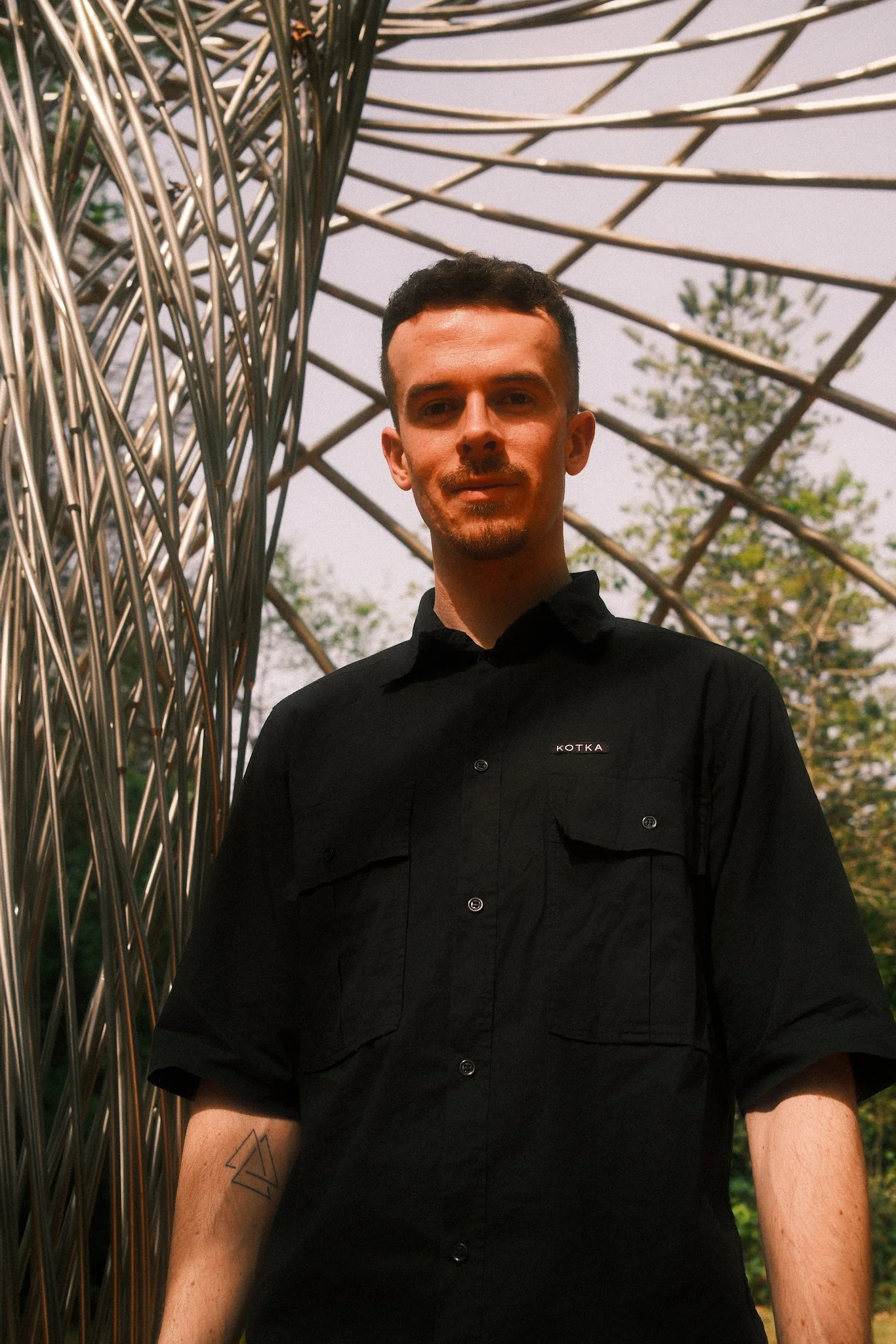
Rosillon
‘‘What connected us in the first place was similar values, our direction in sound, what we like harmonically. I remember it was a pretty cool jam, it came together without words, same as what just happened with the record now. It just comes out, and then you know if you can jam that way with someone, you’re aligned.’’ - Rambadu
Having worked with Rosillon for so many years on various projects, and also seeing his personal artistic journey up close, I can share that everything he does, whether creating an ambient experience, playing vinyl or jamming in the studio, takes his full attention. Listening to him describe those months immersed in the modular, the commitment becomes clear. He continues:
Rosillon: ‘’Actually, when I listen back to those recordings now, some of those jams almost feel like finished tracks on their own. I was so deeply in the flow and felt completely connected to the modular. At the same time, I enjoyed improvising so much that I found it difficult to move beyond the jam itself and start shaping the material into compositions. That was the point where I got stuck. Not long after, Paul and I sat down together in the studio with our modular systems, and suddenly the whole process became fun again.’’ After meeting at Operator and jamming sporadically together in the years that followed, in 2024 one of those sessions became something more - an invitation to co-produce a record to be released on Rambadu’s label. Rosillon continues:
Rosillon: “Well, that was super fun, because we both already really enjoyed that first session. What we noticed back then, I think immediately, was that we shared an interest in sound.’’
Rambadu: “Similar values, our direction in sound, what we like harmonically. I remember it was a pretty cool jam, it came together without words, same as what just happened with the record now. It just comes out, and then you know if you can jam that way with someone, you’re aligned. You don’t have to say anything only if you’re in doubt about the sound yourself. And if there’s doubt on both sides, then it needs to be changed or go away.”
From First Jams to a Finished Record: How Two Studios and a Shared Passion for Music Shaped the Collaboration
Rosillon: ‘’The first session for this project took place here in my studio. You brought over your modular system, we started improvising, and before we knew it we had recorded nearly three hours of material. From that point on, we treated your studio as the main reference for arranging the tracks. Whenever I recorded new ideas on my own, we would always listen back to them in my studio first, because you wanted to hear exactly what I was hearing while making them. I especially remember the very high frequency sounds that carry psychoacoustic energy. You would often say, "These are sounds I normally would not gravitate towards," because they simply did not translate the same way in your studio.’’
Rambadu: ‘’They translate differently and can sound too intense on my hearing when you are still trying to find the sweetspots.’’
Rosillon: ‘’But here, you were saying, "Now I hear what you are hearing in it." I think that was the moment the whole process became even smoother. I got into a flow of reprocessing the recordings with the Digitakt, constantly reshaping the material we had captured and pushing it towards very expressive sounds. I also knew that whenever we met again, you would be listening with completely fresh ears.
That created a really interesting dynamic. I was often listening in a very focused way, paying attention to specific details or ideas I wanted to develop. You approached the material much more holistically. Sometimes the smallest, most accidental sound would suddenly become the centre of attention. I still remember you saying, "The recording is nice, but that crackle from the cable being pulled out, that's what we need." It made me laugh every time. Those unexpected moments became incredibly important. They often carried the tracks forward when we felt stuck. I remember the A track in particular. The core material was already there, but we could not figure out where it wanted to go. It initially had a much more open atmosphere. Once we started introducing all those strange psychoacoustic sounds, and you began cutting and rearranging them in your magical way, everything suddenly clicked into place. In the end, it felt less like arranging music and more like building a collage of sound. Rather than layering ten channels on top of each other, we were constantly moving between what felt like hundreds of fragments and variations, bouncing material back and forth, reprocessing it, and gradually letting the compositions reveal themselves.’’
Rambadu: “Yeah, it’s a fun process. I think you get to a point where the tracks are cool, but they’re not there yet, and you know something’s missing to bring them together. I think that’s the biggest hurdle in finishing a record. You’ve got nice music, but how do you tie it together when, from one session to the next, it sounds quite different? You have to balance them out with each other, and that’s quite difficult.”
I am impressed by the ease with which the two flow into the conversation between each other, and the details they share about their process. What did you learn from Rosillon, in turn? I ask Rambadu:
Rambadu: “Probably to be more free again, and just record for the sake of recording. To use more spatial effects and things like that. Rosillon is very good at these very experimental sounds, which take a lot of dedication to come up with. At least for my process, these aren’t sounds I’d find in a more jam-oriented style. My process has mostly been trying to find the main structure in a jam-like sense, and then tweaking what I’ve recorded in that jam. But this opened the door for me to be more experimental as well, because it gels really well together.”
The making of this record has been a transformative experience for each of them in interesting ways. Each playing to something slightly beyond their usual territory, and finding in the other exactly what was missing. Living in the same city means more than proximity. It meant producing an EP across two different studios, hearing the music from two different points of view, and making decisions based on both.
Rambadu: “Normally you’d check a mix in the car or on someone else’s speakers, but because we were doing this so often, and I think we spent equal time in my studio and in yours, each time you have a different reference point and you get familiar with the unknown speakers. I know how it sounds in my house, so I know what I should and shouldn’t touch there. Then from what’s sounding nice here, you add it in this session, and you can see ‘oh, this is sounding super nice in this studio too,’ or maybe one frequency is off, and vice versa.” So what does the final tuning look like? Every sound system and room translates differently so how do you arrive at the final decision?
‘‘My process has mostly been trying to find the main structure in a jam-like sense, and then tweaking what I’ve recorded in that jam. But this collaboration opened the door for me to be more experimental as well.” - Rambadu
Rambadu: “Finding a balance, I think, is the biggest part. There are so many resonances that are nice - one might be very low in my studio, and you boost it because you don’t hear it properly, but then it’s accentuated in Rosillon’s studio, and it’s like ‘oh my god, what is this frequency?’ So you have to find a middle ground between the studios. My studio isn’t perfect, Rosillon’s isn’t either. We’ve got nice spaces, but they’re not professional studios.”
Rosillon: “I think we use the spaces for different purposes, because in my studio, and that’s partly why I often lean toward the experimental psychoacoustic kind of sounds. I can't put the volume too loud. The room is small, but the higher frequencies are very detailed, and with the geometry of the room and acoustic treatment they create a certain spaciousness. But I can’t push it there the way it sounds at Paul’s.”
They simultaneously finish the sentence “Where you can really blast it!” and burst out laughing. The kind of laugh that tells you everything about how well these two know each other by now.
‘‘Sometimes we’d just lose track of who was doing what, because you’re not even thinking about what you’re doing, you’re just listening, feeling the frequencies beating against each other. The material works together because it was recorded that way. I'm always convinced that when you listen to music, you are listening to what sounded interesting in the room where it was created. The room becomes an integral part of the creative process. That is why it was so fascinating to hear what happened when our two listening environments came together." - Rosillon
Rosillon: “It was great to really be able to push it like you’re in the club, especially because your monitors are completely different. You have three-way monitors, so you actually have a mid driver too, which gives you way more definition in the mid-range, more control over certain resonances. I think that combination created a very interesting result, and that’s also what makes it personal and authentic. During the recording process we weren’t talking, we were just mute for three or four hours, turning the knobs. The only moments we’d say something were like ‘Is that sound you or me?’ and then we’d turn down the volume on one side ‘oh yeah, I think that’s me.’ Sometimes we’d just lose track of who was doing what, because you’re not even thinking about what you’re doing, you’re just listening, feeling the frequencies beating against each other. The material works together because it was recorded that way. I'm always convinced that when you listen to music, you are listening to what sounded interesting in the room where it was created. The room becomes an integral part of the creative process. That is why it was so fascinating to hear what happened when our two listening environments came together."
This is the moment to pause on Rosillon for a second. There is something striking about the way he talks about music. Focused, calm and at peace, the words coming with the same care and precision he brings to everything he does. The love he has for sound is not performed, it simply radiates. He explains things in detail, with patience and clarity, and listening to him you understand immediately why the studio is not just a workspace but something closer to a calling.
“α δ”: Interplanetary Transmissions, Coordinates and the Space Between the Familiar and the Unknown
I want to take a different direction and talk about the EP specifically, because it has a fascinating concept behind it. What came first, the music or the idea? Did the concept shape itself alongside the music, or did it arrive after? You both had so many influences over these two years. There has been transformation in your private lives. You Paul have worked on your label, traveled to faraway places, gotten engaged, started a family, and Rosillon, you have discovered new creative outlets beyond music like photography and literature each opening your world and your way of seeing in ways that now flow naturally into everything you create, all while continuing your other projects like Embodiment and your DJ work. So how did the concept, the story and the music all come together?
Rosillon: “I’m normally someone who’s very conceptual from the start. With DJ mixes, the stories in my head are very abstract, they make perfect sense to me, but I can’t always explain them to people. It’s like, when I’m sequencing tracks, I know what the story is about, but it can only be felt, not explained. For this one, though, we didn’t start with a concept, per se. It was not like we sat down and said, "Let's make a record." We simply got together to make music. It was only afterwards, when we listened back to what we had recorded, that we realised there was something special there.’’
Rambadu: “Free and natural, yeah. I’m the same, though I normally work more with a theme, or an idea or a concept. For example the release with Claudio PRC, it was very water-influenced; the record before that was more about plants, leaves, rustling, wind. That sets a kind of boundary or not necessarily that, but it puts you in a certain corner: okay, what can I explore in this area that’s different from what I’ve done before? With this one, the idea of it being about space came later, but I think if we had set that intention at the start, we’d have hit the mark pretty well too, because it’s quite spacey, very esoteric, very out there, mentally. It brings you in and there are a few ‘whoa, what’s going on’ moments.”
‘‘I normally work more with a theme, or an idea or a concept. That sets a kind of boundary or not necessarily that, but it puts you in a certain corner: ‘Okay, what can I explore in this area that’s different from what I’ve done before?’ With this one, the idea of it being about space came later, but I think if we had set that intention at the start, we’d have hit the mark pretty well too.’’ - Rambadu
Sitting here listening to them, I feel the warmth of this afternoon settle in. There is something about being in a room with two people who have built something together out of genuine passion and shared values that is hard to put into words, you simply feel it. And there is something else worth naming here. When I first sat down with Rambadu for our Nachtblumen feature in 2022, he spoke about wanting his label to be a platform for like-minded artists - a place to support and bring forward people doing this kind of music in Rotterdam and beyond. Rosillon sitting across from him today, about to release his debut as a producer on that very label, is proof that he got there! Rambadu built exactly what he set out to build, while staying true to himself and his vision. I feel pride and joy to have been part of the journey so far too. Circling back to the record if I had to describe it in one word, psychedelic comes closest. Paul nods:
Rambadu: “Calm and sweet, but at the same time very far out there. I think that’s the beauty of it.”
Rosillon: ‘’For me, it feels like contact with another form of life. Not in the science fiction sense of an alien that resembles a human, but more like encountering a presence. When I listen to the record, it feels both familiar and unfamiliar at the same time. There are field recordings that clearly belong to the Earth we know, but alongside them are synthetic sounds that feel as though another presence is piercing that reality. For me, those two worlds do not contradict each other. The closest comparison I can think of is that moment in Interstellar when Cooper enters the black hole. As a three dimensional human, he is briefly able to perceive time as a physical space through a higher dimensional construct. That shift in perception is very close to the feeling I associate with this record. It is not about outer space itself, but about stepping into a reality whose rules you don’t yet understand. That is also why we chose coordinates as track titles. They point to places that carry a certain mythological quality, places that invite the imagination rather than explain themselves. I like the idea that listening to the record is a bit like being drawn into a black hole. There are sounds you recognise and can hold on to, but at the same time you realise you are no longer experiencing the world in the way you are used to. That intersection between the familiar and the unknown is where this record lives.’’
Isn’t that also true of your collaboration? You are both surprised by the things you discovered in sound, but there is also something familiar as a foundation. It is exactly how you work together, and that is reflected in the music and in the story.
Rambadu: “I think it was also your photos that sparked the idea that these are like little universes. We had A, B, C as names for a long time, and then once you finish the music, it’s the moment you wonder what are these going to be named? I knew it was going to be a kind of pinkish sound and color, so I asked Rosillon to show me pictures he’d taken that translated that atmosphere.”
Rosillon: “With the camera, I just found a way to make the pictures feel close, color-wise, to the color of the record. It started with photographing nature, because I love doing that. The first option was a tree, I remember, but then it became more about reflections. When you really zoom into the photos, you start asking yourself, ‘What am I actually looking at?’ That brings me back to what we were talking about earlier. I am fascinated by the space where reality and imagination meet, because where does one end and the other begin? If you allow yourself to look beyond the symbolic meaning we have learned to assign to things, who is to say there is not something else waiting to be discovered?’’
Rambadu: “Yeah, it starts to slowly click, and then you’ve made the decision, and you find out ‘oh, actually this makes a lot of sense to go in this direction’. The stamp is also very star-like, in my mind. I started designing it last year because it is a long process and I wanted to give it the proper time.”
It is a good moment to mention that the collaborative side of the project extends even further. Rambadu’s fiancée Camille de Bruin, a full-time artist, is involved in the art side of the label and contributed to this record too.
Rambadu: “Of course. She’s definitely a big influence as well, and helps with fact-checking my work.” says Paul with a big smile on his face.
Rosillon: ‘’Now that I think about it, B2 opens with field recordings of water. At first, you might wonder, What does water have to do with a galaxy? But if you asked someone what they see on the cover of the record or on the centre label, they would probably say, "A galaxy." In reality, it is a close up of water. I love that loop. You hear water at the beginning of the track, and then you encounter it again on the artwork, only this time it has become something entirely different. It starts to resemble a galaxy. So where does one end and the other begin? How can water not be the galaxy?’’
Rosillon demonstrates his vast imagination once again by contemplating on this question. He is an artist who not only feels but thinks deeply. The coincidences that accumulated as the concept took shape were hard to ignore, and they kept arriving without being looked for.
For the ‘α δ’ EP, Rambadu and Rosillon leave our earthly plane behind to explore the vast unknown, interplanetary transmissions of intricately layered sound, establishing contact with three distant regions. Each track carries a precise astronomical coordinate as its name, places with a mythological weight that the music seems to have already known about before the concept did. Somewhere between dream, memory and reality, new worlds emerge.
Today we premiere the A side - α 05h 40m 45.5s δ –01° 56′ 34″ the first transmission and the point of first contact. I consider myself lucky to have watched this project from the sidelines over the past two years, to have observed the process and heard the music develop in real time. It is something else entirely to see how much work, how many decisions and how much courage it takes to arrive at something finished. Personally I feel a strong connection to this track, as it is a pulsating drone that leads you on a journey, while all the psychoacoustic spatial sounds start to open door after door in front of you. It is a piece of music that puts me easily into a meditative state. You mentioned earlier that the track used to be different, and that at some point it changed. What is the story behind that?
-
Starting our journey at "α 05h 40m 45.5s δ –01° 56′ 34″" we marked our first encounter of the fifth kind, initiating a clear line of communication.
-
On our second exploration we travel many more light-years away and stumble upon the rogue object "α 18h 01m 31.25s δ –29° 07′ 46.20″".
-
The third location "α 19h 01m 27.98s δ +39° 16′ 48.25″" dissolved the remaining assumptions we had about habitable zones.
-
Written & Mixed by Rambadu & Rosillon
Mastered by Giuseppe Tillieci at Enisslab Studio
Artwork by Camille de Bruin & Paul Roeleveld
Rambadu: “It didn’t really change from where it is now fundamentally. It just became more complex, I’d say.”
Rosillon: ‘’I think the mood changed over time. In the beginning, we imagined the A side as something lighter and the B side as something darker, but eventually those two worlds grew much closer together. I think that also helped shape the space theme that runs throughout the record. It was fascinating to experience how drastically changing the volume of certain key elements could suddenly open up an entirely new direction. In the end, it is all a matter of perception. When I listen to the record now, I sometimes hear a sound and think, 'I remember this from an earlier draft,' when it was much more pronounced and gave the track a lighter feeling. Now, that very same sound sits further back in the mix while other elements cluster around it, and suddenly it feels quite different.’’
Rambadu: “It gets more muted, in a way. I think this is also where, to finish a track, you need to stay free. It’s easy to say ‘this is what we made, it’s good, don’t touch it anymore,’ but that’s also your worst enemy. It’s a fine line between not touching it and saying, ‘Okay, fuck it, we’re going to make changes.’ ”
Rosillon: ‘’This is still something I am learning to let go of. Sometimes I feel like I have invested so much into getting a track to a certain point that it almost feels wrong to suddenly take it in a completely different direction. Working together on this project taught me that those moments of radical change can actually be the ones that move a piece forward.’’
Rambadu: “Aside from some spatial effects on top, the change came from within. It’s not like we made fully new recordings to completely change the track around. We just dug in deeper with what we already had and looked at how we could modulate and change certain parts that were already present, to give it more power. I think that’s what was lacking. The happiness was there, true from start to end, in a nice way, but then where does it take you?”
Rosillon: ‘’If I had to think of an analogy for how I see it now, it would be carving a sculpture from stone. You do not create the sculpture by adding more. The material was already interesting, but my instinct was to keep escalating it, as if it needed to become something bigger. Paul helped me realise that it did not need to become more, first rather needed to become less. We had to create space so that what we initially thought was the beginning of the track could become its body instead. Looking back, I see that you can only reach that point by first carving enough away, and then rebuilding the track so that every element contributes to its core structure. We started running the material through external effects pedals and treating them as instruments, improvising with them just as we did with the synthesizers. It became a really effective way of creating new sounds that naturally shared the same DNA as the original material.’’
Rambadu: “Yeah, the same goes for me. If I’d made it by myself, I probably would have made different decisions, and it wouldn’t have gotten as detailed and refined, or maybe ‘refined’ isn’t the right word, but a lot of thought went into this track. Everything in there makes sense until it doesn’t really make sense, you know?!” I actually don’t know what he means by that, so I ask Rambadu directly, have they broken any production rules in the way they arranged things?
Rambadu: “That’s not quite the right word, but there are a lot of surprising elements in there that I wouldn’t normally use or come up with myself.”
Rosillon: ‘’Some of the material began as sequenced recordings, but from that point on, nothing remained conventionally locked to the grid it was originally recorded in. We pulled everything apart, stretched it, cut it up, rearranged it, and treated it as raw material. It gradually became a collage of sound, where all these small fragments formed their own landscape. The result feels fragmented, yet somehow it remains cohesive.’’ It does not sound familiar, I add.
Rosillon: ‘’Apart from an 808 kick, every sound was synthesised from scratch, complemented by some field recordings. Building the sonic palette in this way gave us complete freedom to shape the deep listening experience we were aiming for.’’
Undoubtedly a listening experience, one where you drift into a new world, doors opening one after the other. It is the perfect welcome to the universe Rambadu and Rosillon have created together.
Inside the Machines: The Modular Synthesizers and the Gear That Shaped α δ
As this is the first time Rosillon has spoken publicly about his production work, and Paul is an equally passionate and technically curious artist, I want to go deeper. We have covered the process, the concept and the track, now it is time for the gear.
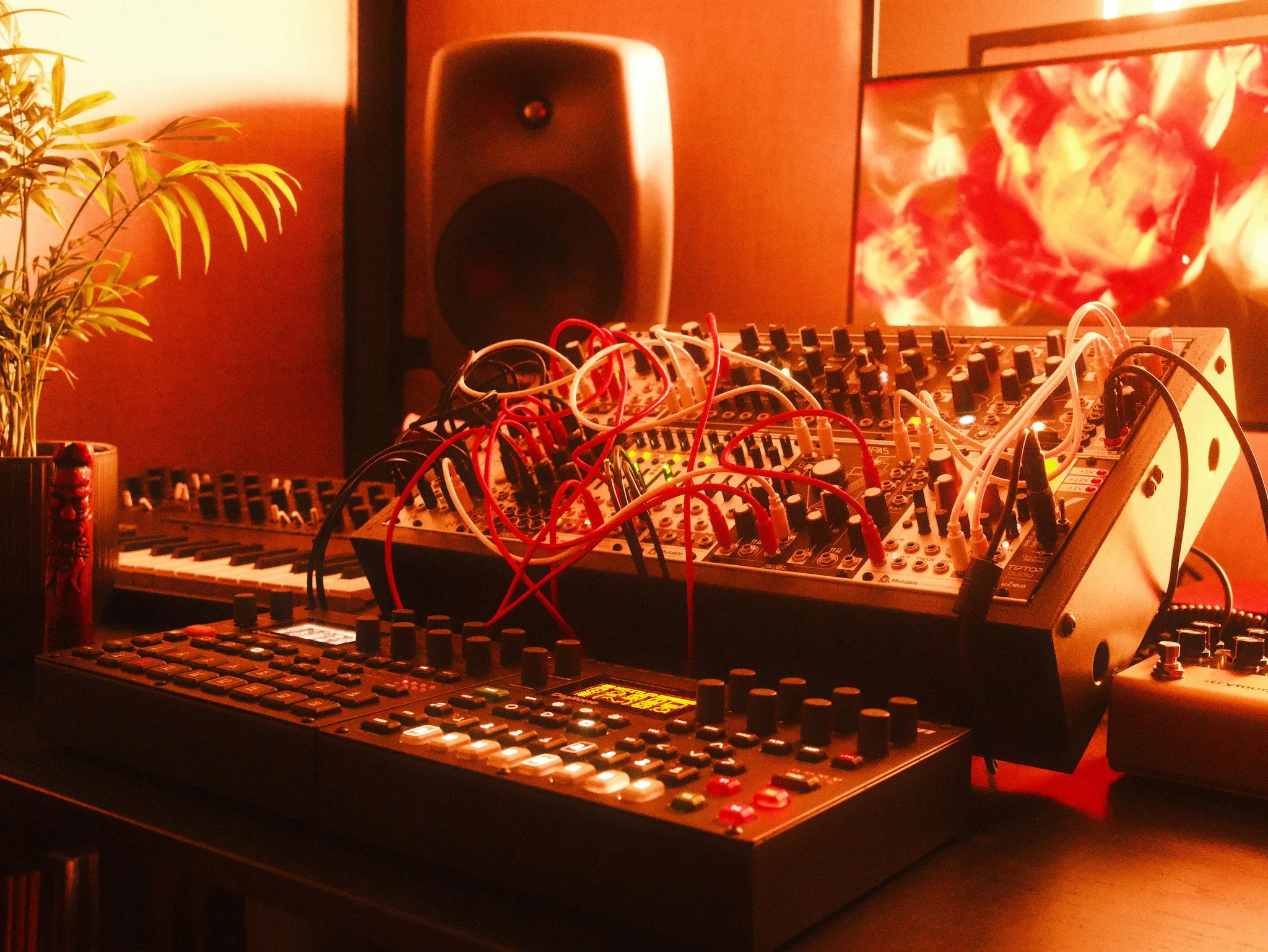
Rosillon: ‘’We both have the Mutable Instruments Elements. I think that was your first module, and it was mine too.’’ he turns to Paul ‘’ We also used it on this record, but the module I keep coming back to is Mutable Instruments Beads, the successor to Clouds. It is a granular processor that I often place at the end of a patch to transform other sound sources.
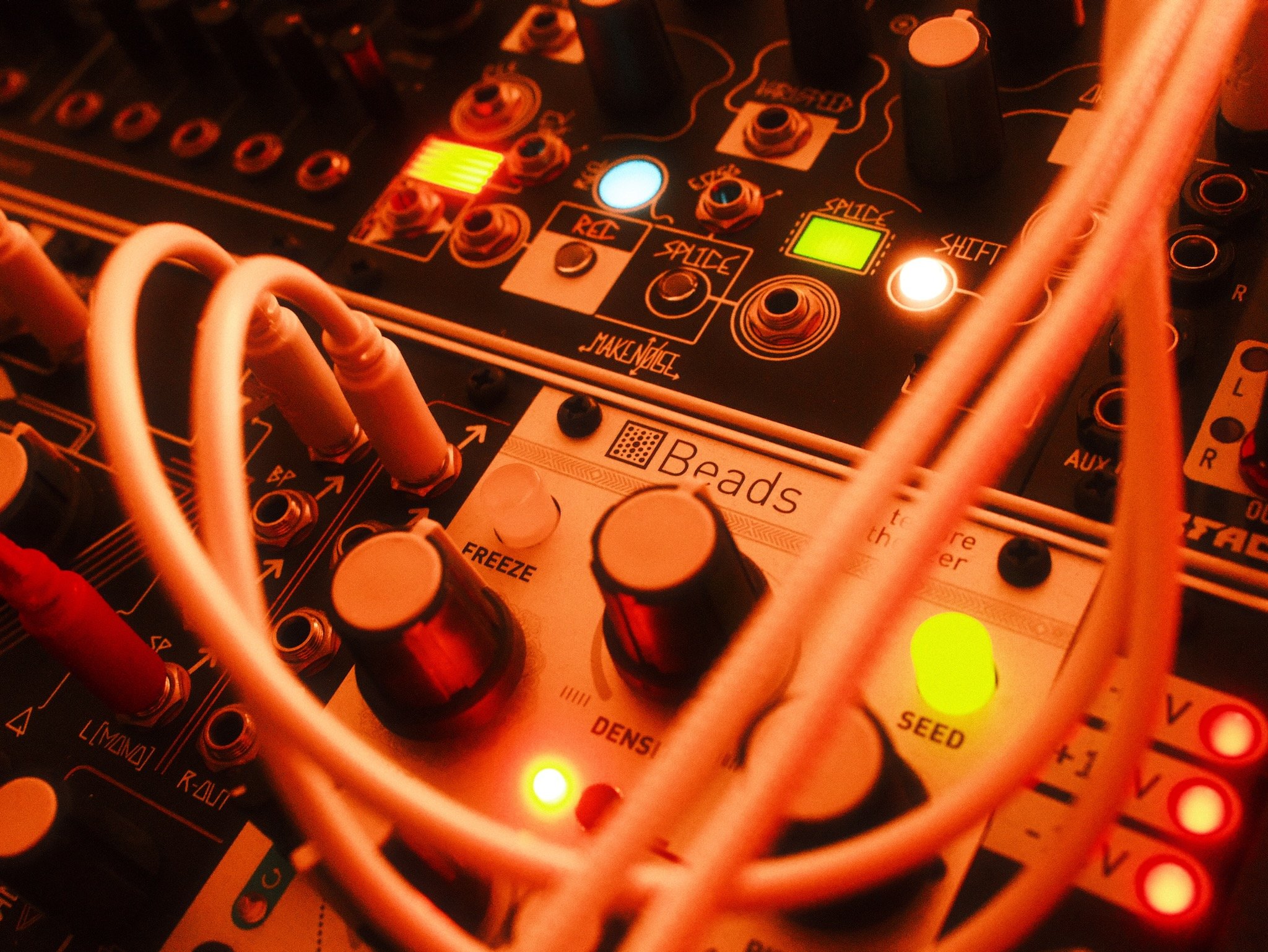
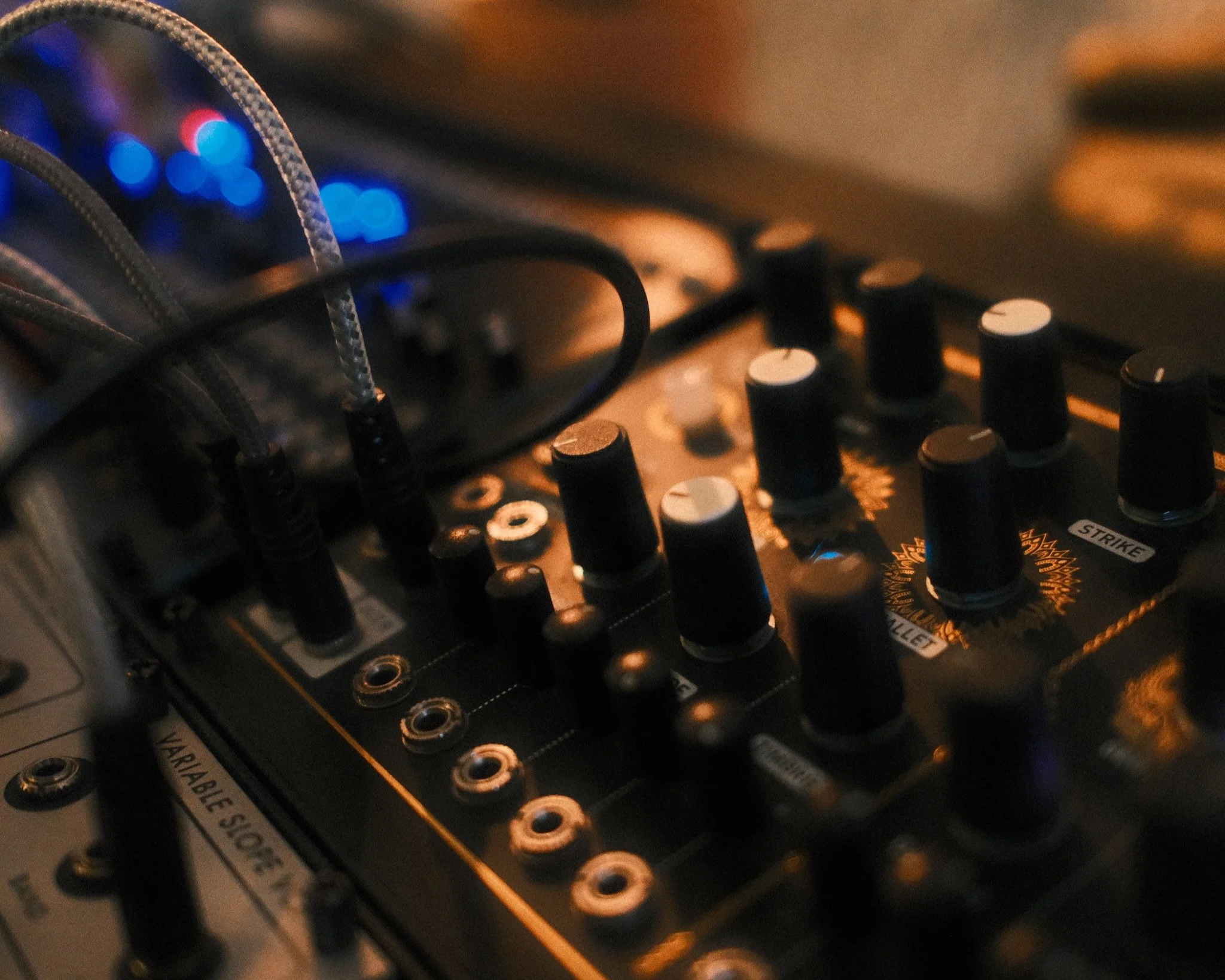
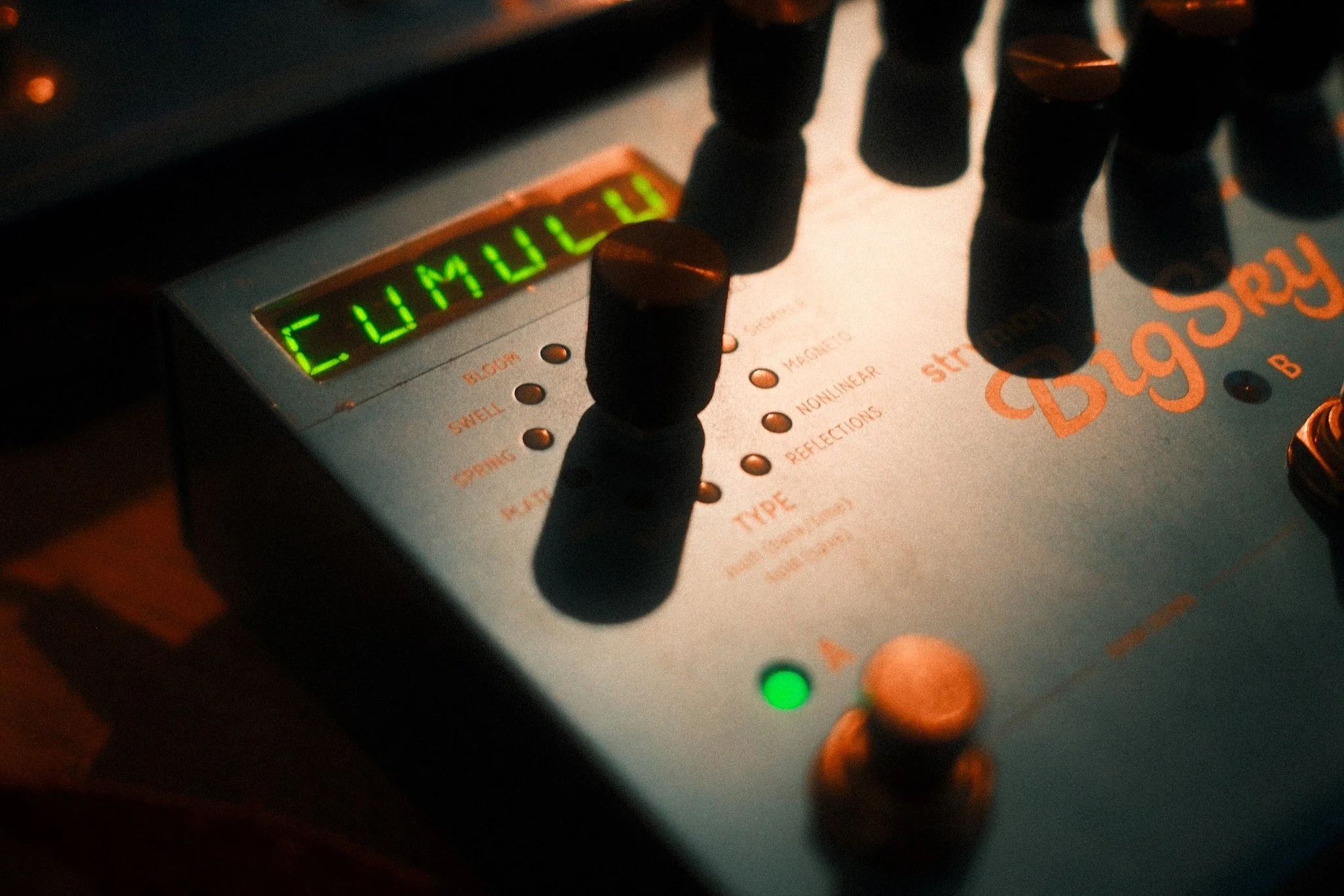
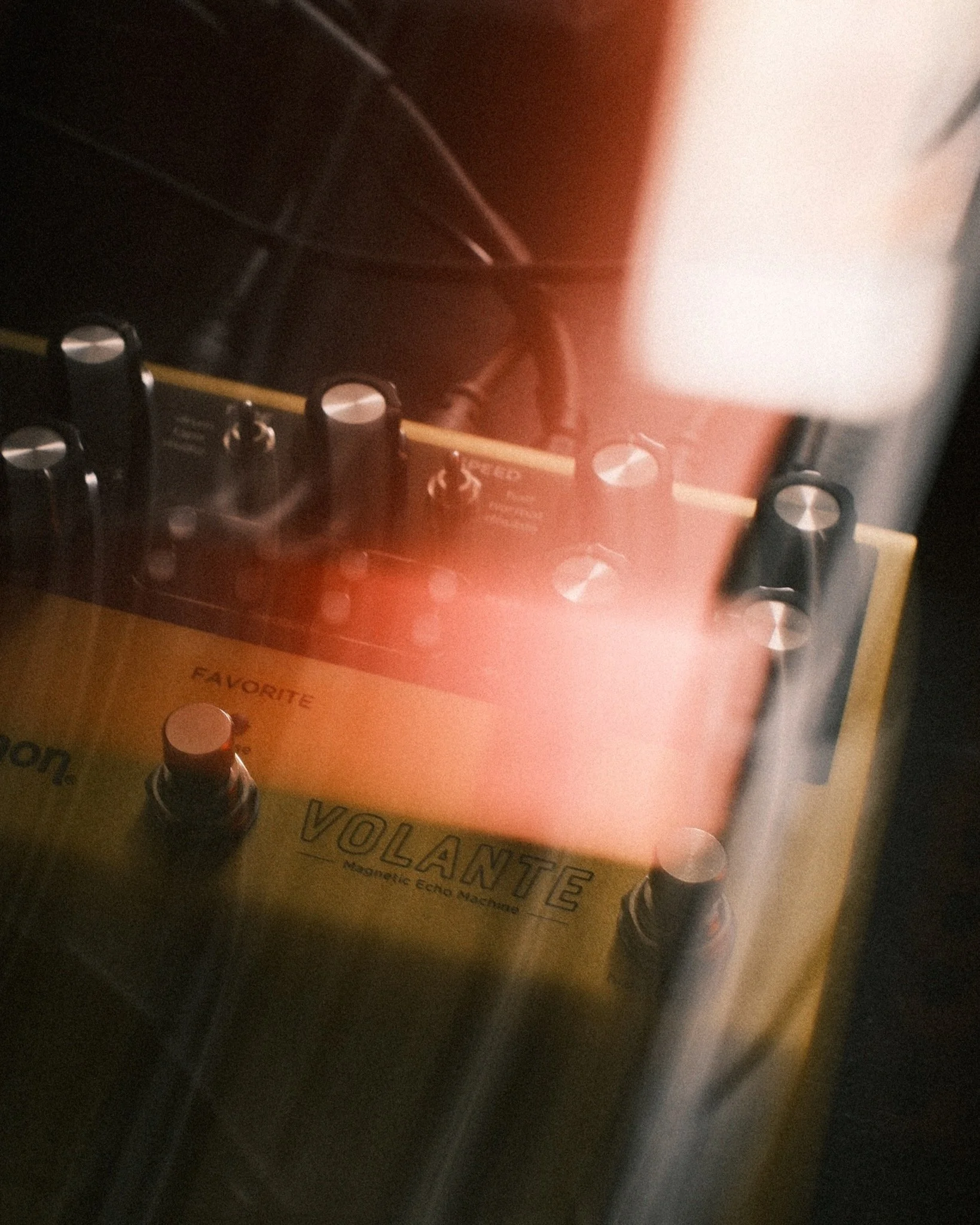
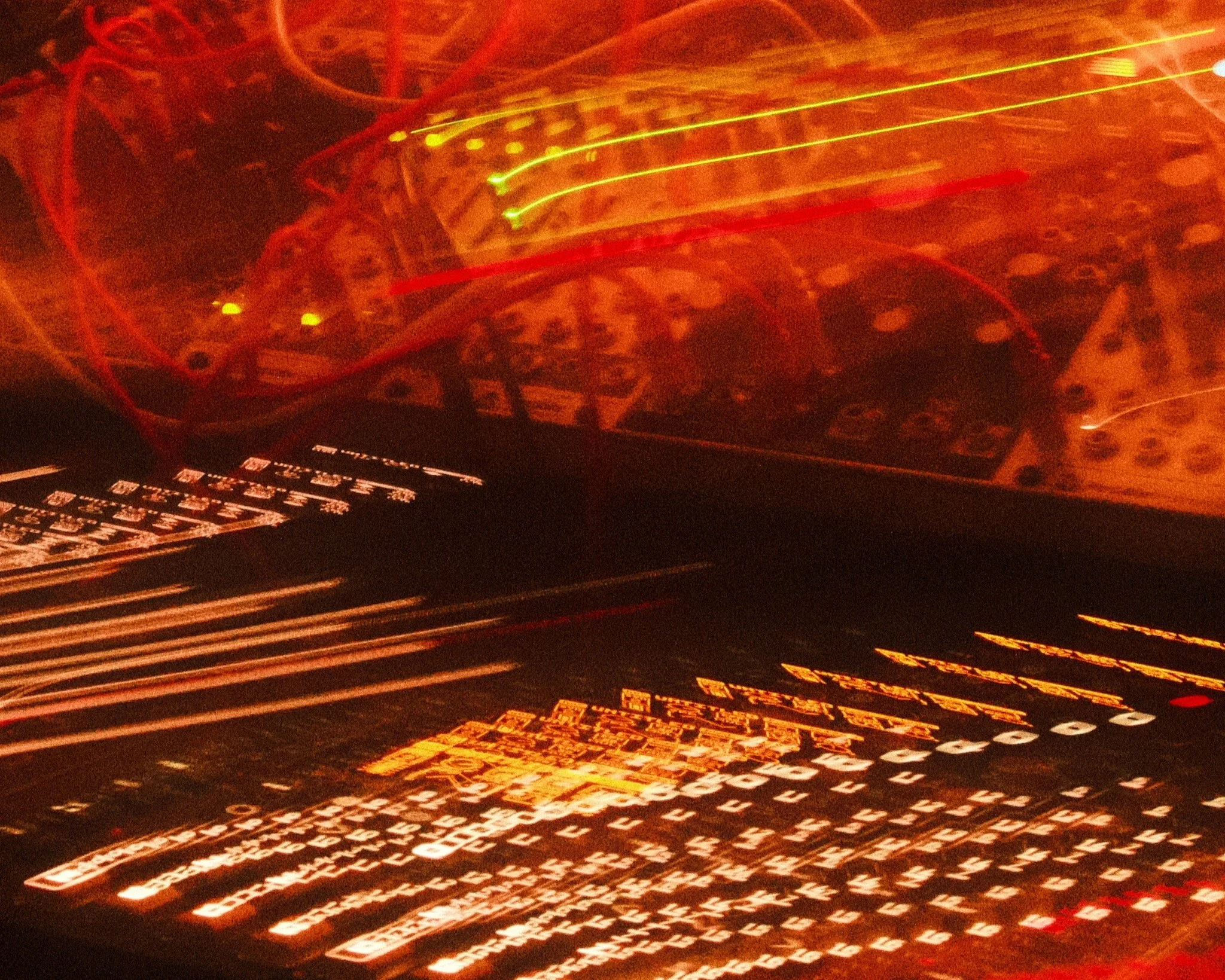
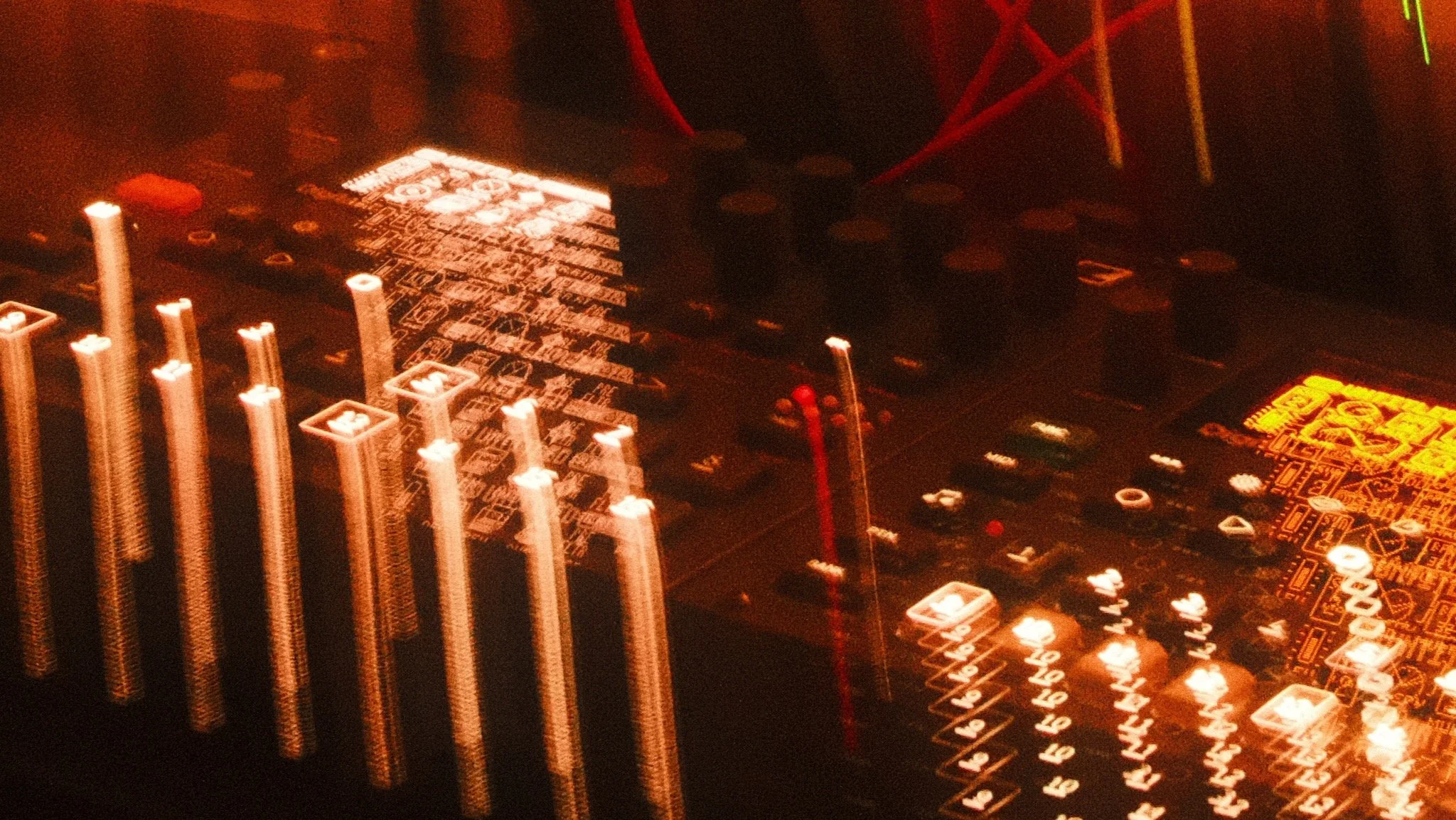
That is also why I love making long recordings. Sometimes it takes a while before I find the sweet spot, but once I do, it almost feels like I am synchronising with the instrument. There are long stretches where I am simply navigating the stereo field, going on a quest. The sounds can become incredibly abstract, but working together with Paul showed me how those textures can become part of something much more tangible. For me, the modular is only the beginning of the process. Sometimes a recording already works on its own, but I like to discover what is hiding in the material when it is put into a sampler. The Digitakt is really great for that because of how freely it lets you modulate almost every parameter. We also used the Roland JU-06A, processed through effects in Ableton, to create the bell-like sounds on the B2 track. For the external processing we mentioned earlier, we used the Strymon BigSky and the Strymon Volante. I often find myself improvising to a point where it barely sounds musical anymore. At that stage, I am no longer thinking in terms of melodies or harmonies. I am simply searching for sounds that feel strange, spacious, and otherworldly. That is the part of the process I enjoy the most.’’
‘‘That is also why I love making long recordings. Sometimes it takes a while before I find the sweet spot, but once I do, it almost feels like I am synchronising with the instrument. There are long stretches where I am simply navigating the stereo field, going on a quest. The sounds can become incredibly abstract, but working together with Paul showed me how those textures can become part of something much more tangible.’’ - Rosillon
Rambadu: “I’d say it’s mostly modular-based. I’ve got the Elements, and some Serge modules that have become my main pieces.” Serge modules catches my attention and I ask Paul to tell me more:
Rambadu: “It’s from a developer, a brand from back in the day that used to be its own format, like Buchla, very respected. Buchla and Serge were the big players in that space. This Random*Source is now making some of those older modules available as Eurorack, working together with Serge, the original creator, to elaborate on previously made modules, so it’s more accessible and less expensive than buying the old Serge format.”
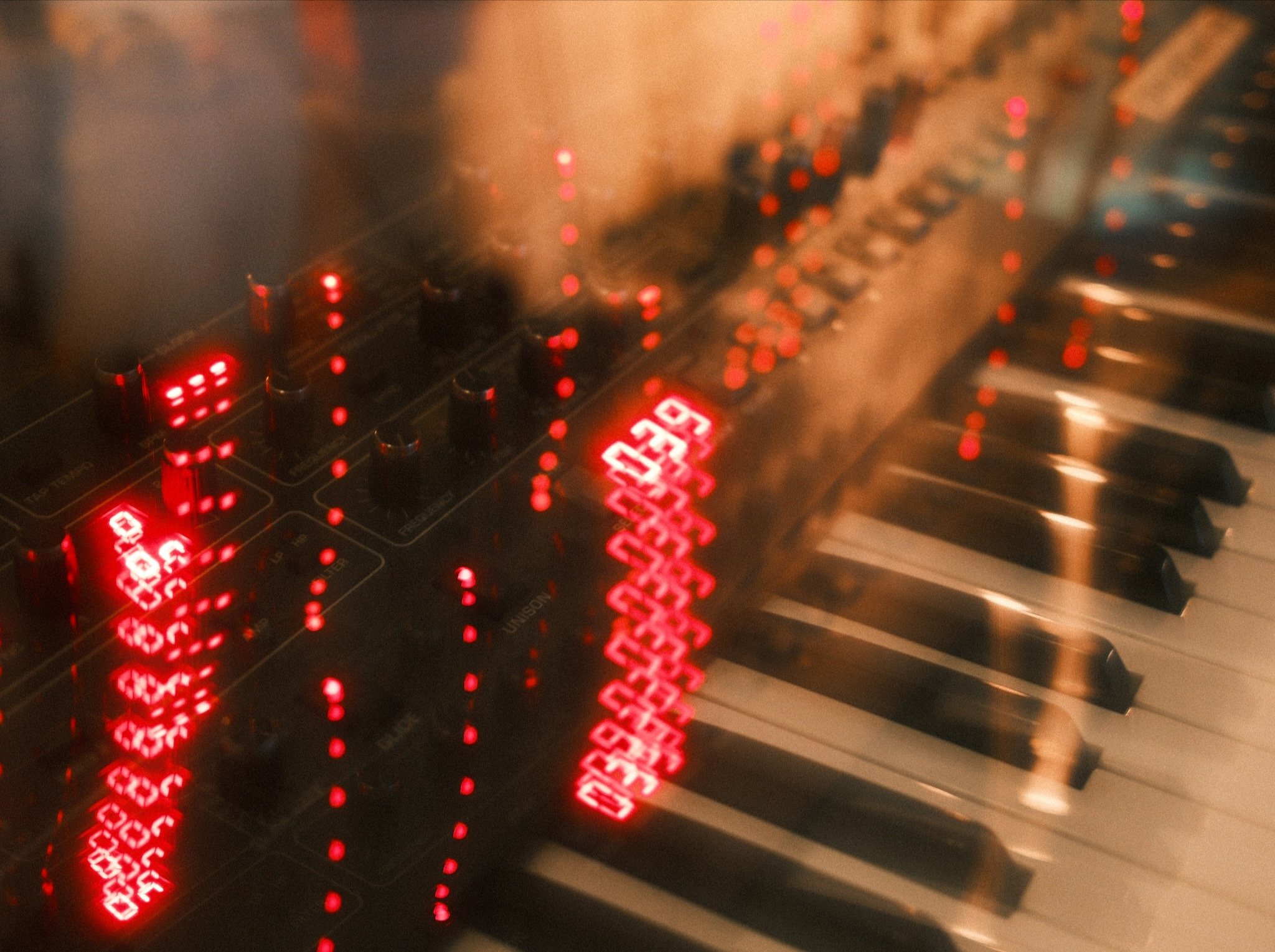
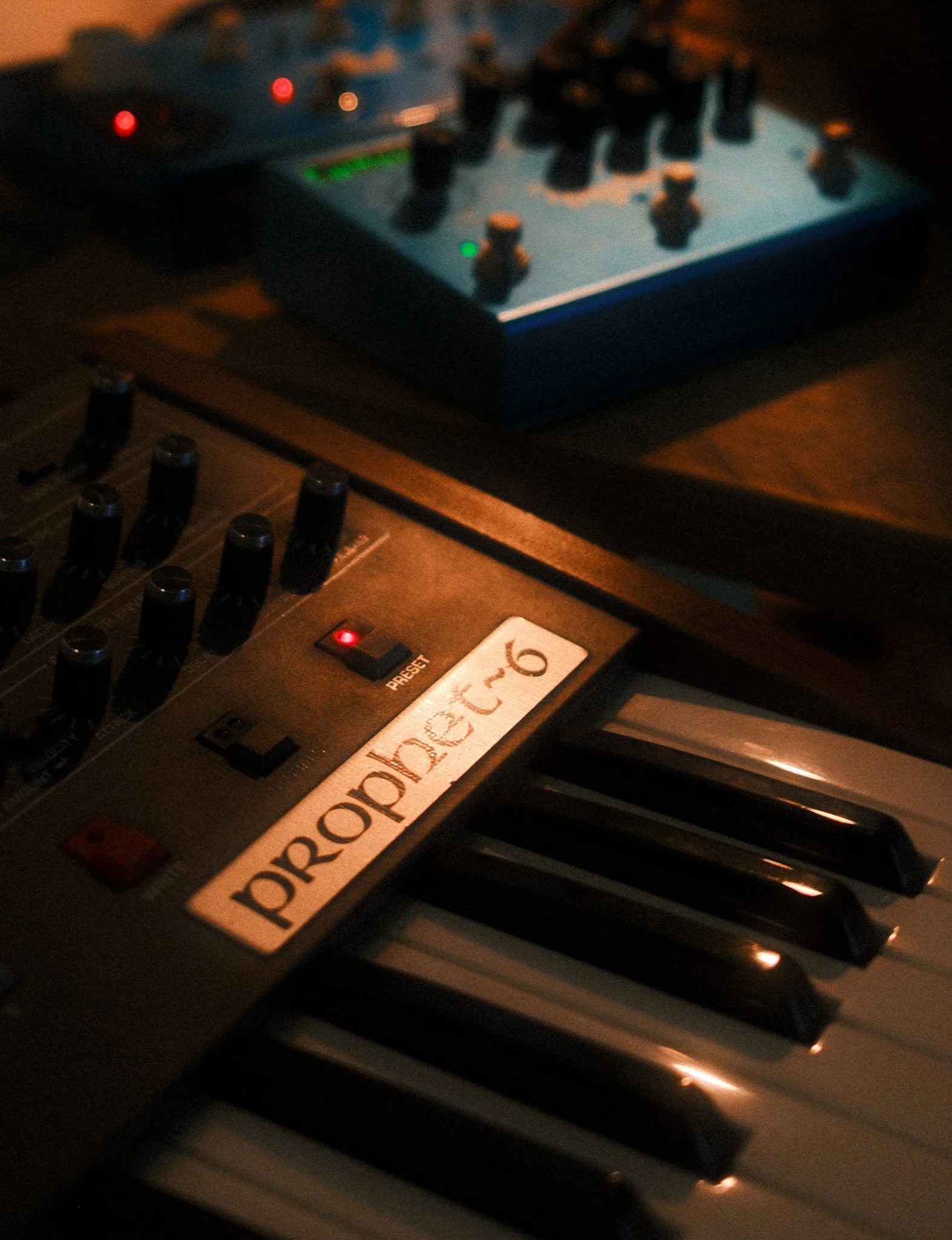
Rosillon: ‘’We also used the Sequential Prophet 6. Quite a few sounds on the A track originated from it. Another piece of gear that should not go unmentioned is the SSL Big Six.’’
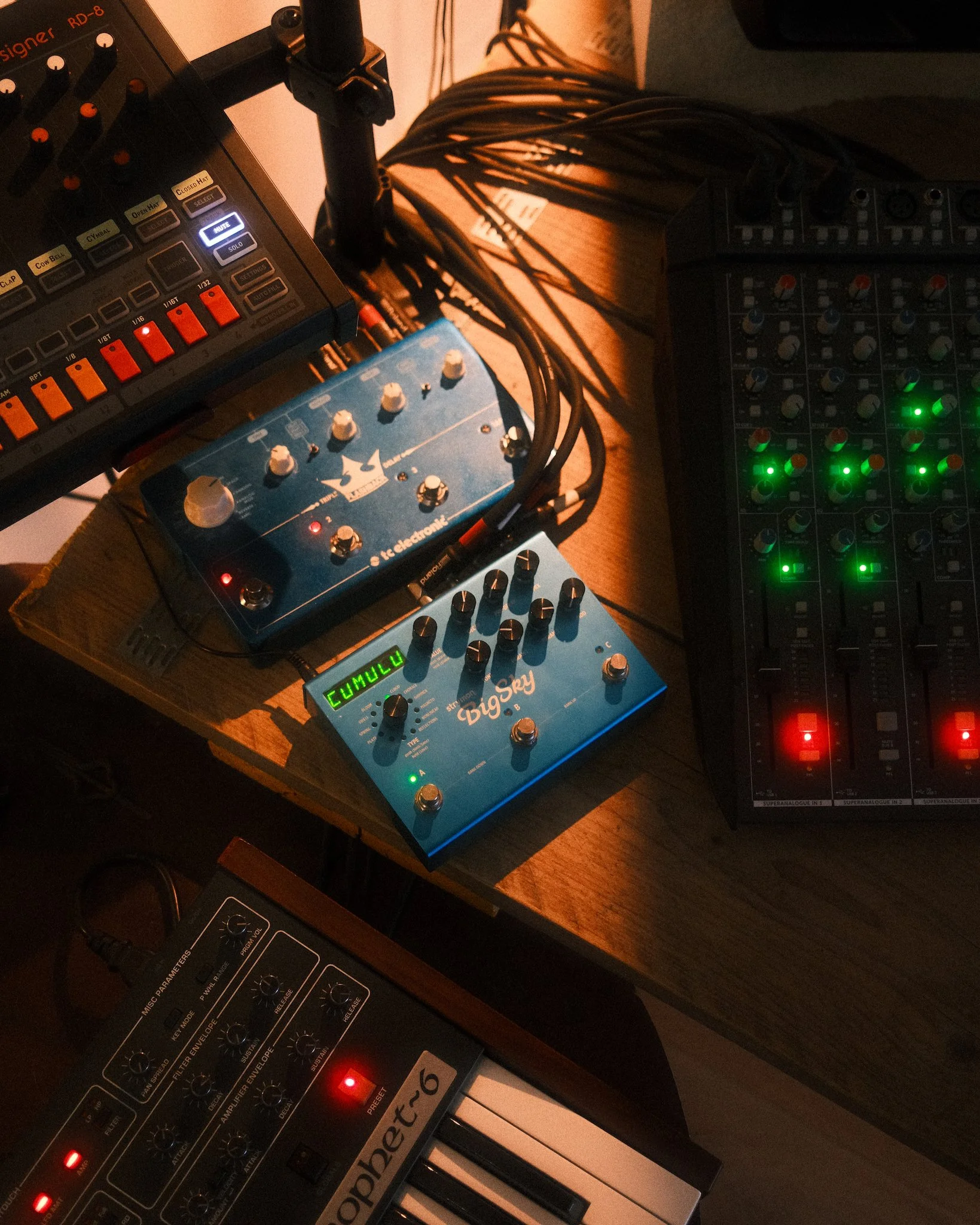
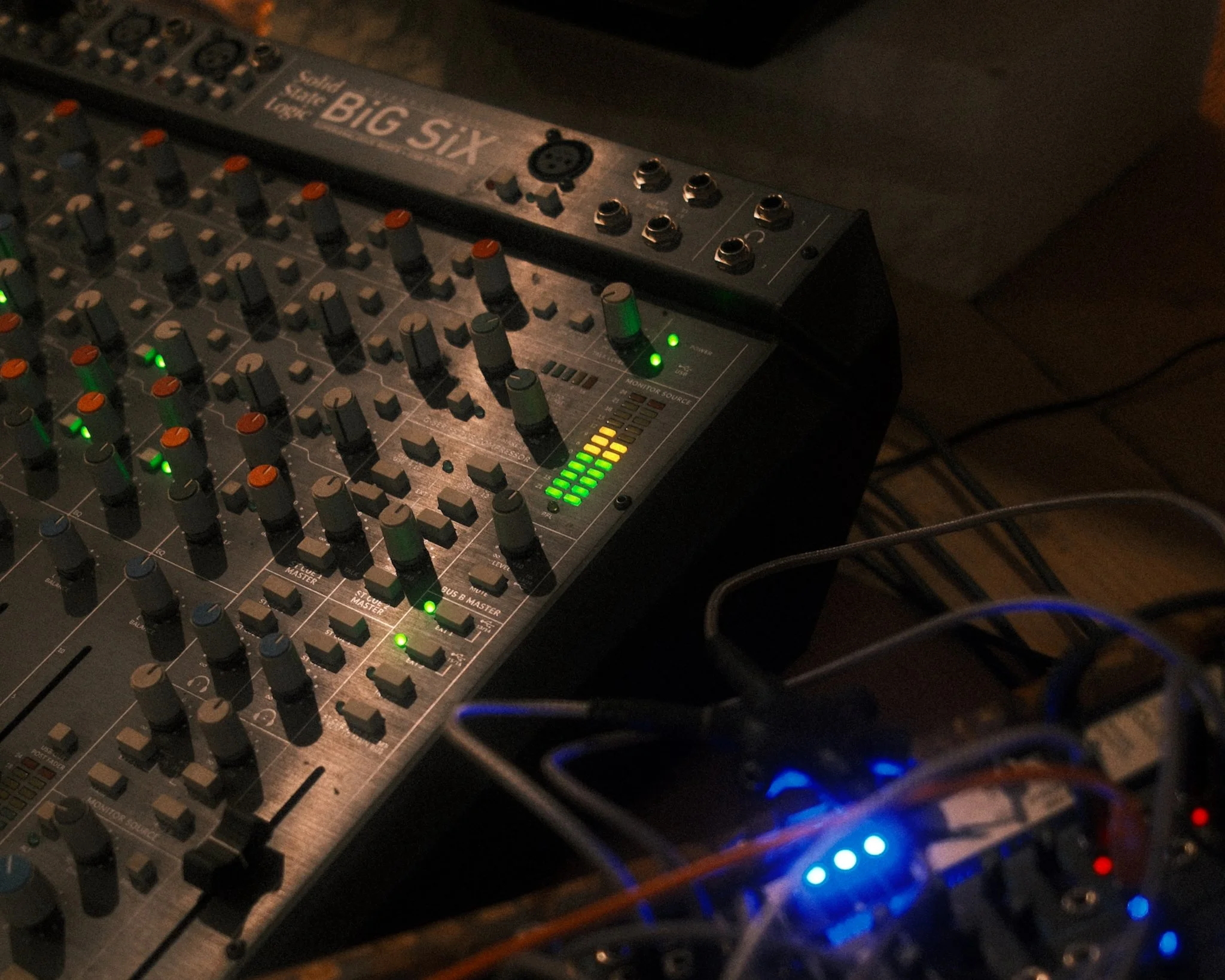
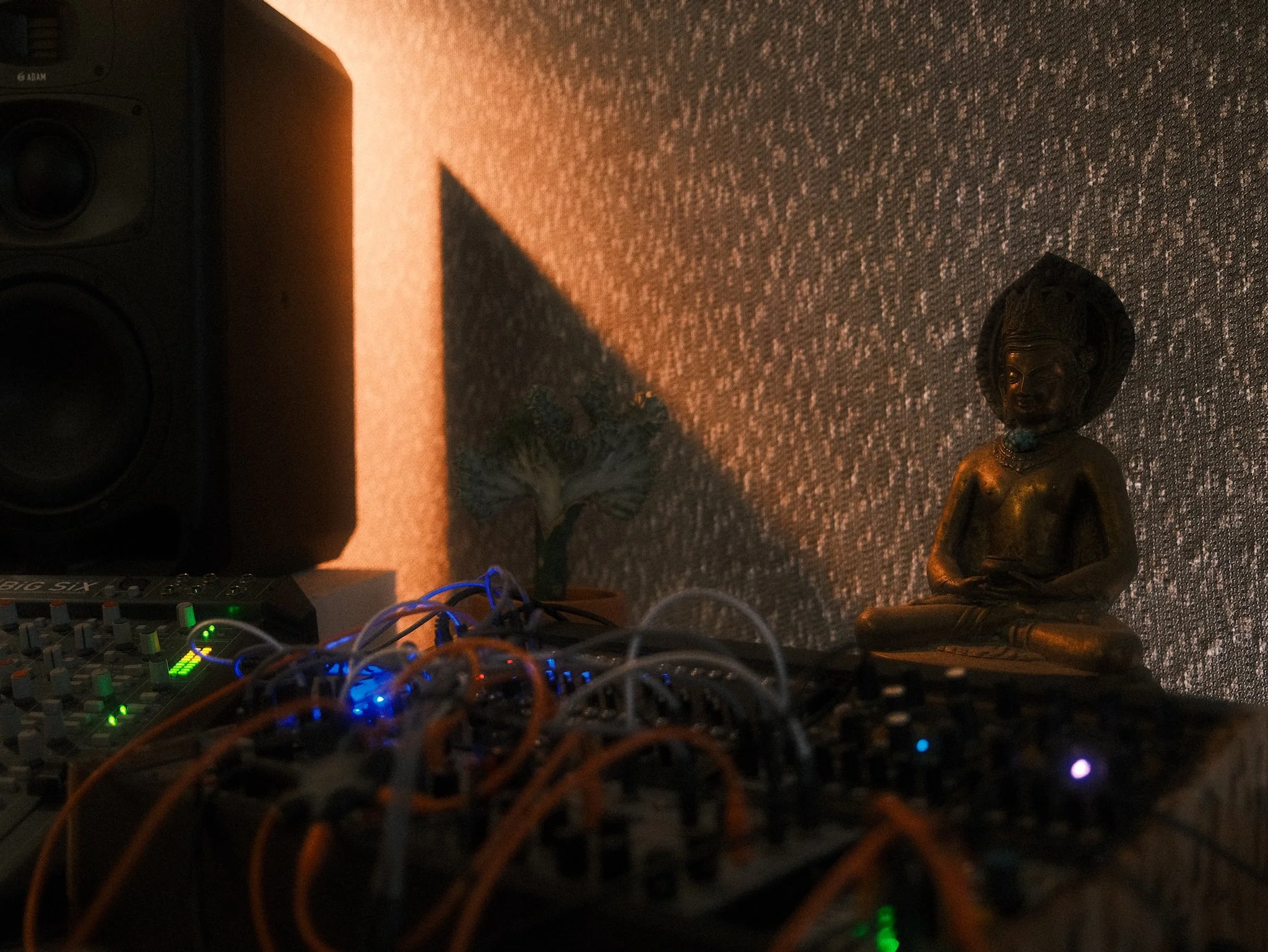
Rambadu: “I had just gotten it when we started finishing things - a recent addition to the studio. I needed a new sound card with more options, and this gives you a mixer with a built-in sound card, so it’s easier to patch into the computer and you don’t need all these extra cables. Normally you have a mixer, then you send it out through a sound card to your computer, but this is all in one, with really good options, and it makes the final mixdown a lot easier and you end up with the right headroom. Since I’ve had this one, I’ve had a lot less trouble with the final mixes.” It is always interesting to hear how one addition to a setup can shift the entire flow of finishing a record.
Rosillon: ‘’It was incredible to hear what the analogue circuitry did to the grouped signals. It added a subtle warmth and colouration that helped glue the mix together in a really natural way.’’
Rambadu: “Analog summing, basically mathematically summing it together. Normally you’d record everything digitally, enable it all, press bounce, and get a finished track, but here we separated all the elements out on the mixer and recorded it like that, so the final mix is analog recorded as one piece instead of digital.’’
Rosillon: “Which also means we had to run it quite a few times, because every recording of it comes out a little different. Not with imperfections per se, but the circuit behavior is never quite the same.”
Rambadu: “Generally, once I sum it, I don’t touch the mixer anymore, so all the settings stay roughly the same, and between tracks I write down the changes on a template sheet you can print out a layout of the mixer with all the knobs and buttons on it, where you mark the ones that were different. You could also do this with Modular patches, but that is way more complex and complicated to do.. But useful if you make something amazing.’’ Clever and a small but telling detail about the level of care and attention that went into every stage of making this record.
‘‘It is a constant dialogue. ‘What happens if I do this?’ The instrument responds, and then you decide how to react. Over time I realised that this is not something unique to modular. It is really a mindset. I have started approaching my other synthesizers in exactly the same way, and making music has become much more enjoyable because of it.’’ - Rosillon
Rambadu: “Especially with the modular, I think it can teach you a lot about what you’re actually doing, because most of the time you’re just patching - this goes in here, this goes in there and you end up with something nice, without always being fully aware of how, or able to reproduce it. I’ve started writing a lot of it down now and it gets printed into my mind. I’m more aware of the process in general now.”
Rosillon: ‘’That is one of the things I love most about modular. I remember that during the pandemic, when you were still living in Berlin’’ says Rosillon turning towards me ‘’I went to a modular workshop at SchneidersLaden. The person leading it said something that has stayed with me ever since. With modular, you do not approach it like a conventional synthesizer where you already know where you want to end up. Instead, it is like having a conversation with the instrument. You have to listen to what it is telling you. If you do not understand where it is leading you, or you simply do not like the direction it is taking, you take a step back. Then it becomes your turn to respond and guide the conversation somewhere else. It is a constant dialogue. ‘What happens if I do this?’ The instrument responds, and then you decide how to react. Over time I realised that this is not something unique to modular. It is really a mindset. I have started approaching my other synthesizers in exactly the same way, and making music has become much more enjoyable because of it.’’
Here both of them are equally in their element passionate, precise, and completely alive in the technical conversation. Listening to them move through modules, signal chains and analog summing, you understand that for Rambadu and Rosillon the gear is never beside the point. It is the physical extension of how the music “thinks”, and α δ is the clearest proof of that yet.
What α δ Leaves Behind and What the Future Holds
Rosillon’s debut as a producer and a first detailed look into his studio world on one hand, and Rambadu’s sound evolution in recent years on the other this was a conversation I did not want to end, and one I am glad to be passing on to you in full. To close it off I wanted to ask them both what is the mark this record would leave on each of them? As an artist, everything you create stays with you in some way. How are you going to remember this time?
Rosillon: ‘’For me, this record represents one of my biggest dreams of the past six years coming true: releasing music. More than anything, though, it celebrates a friendship that has only grown stronger over time. I think that deserves to come first. It has been quite a journey, from discovering one of Paul's records at Clone to creating one together.’’
Rambadu: “Meant to be from the start, this needed to happen! It kind of proves to me that you should open yourself up to people, and maybe that’s what I’d take from the process too. A small thing like that can grow into something bigger and quite valuable, I think. And it’s just a fucking nice record.” Says Paul, erupting into laughter.
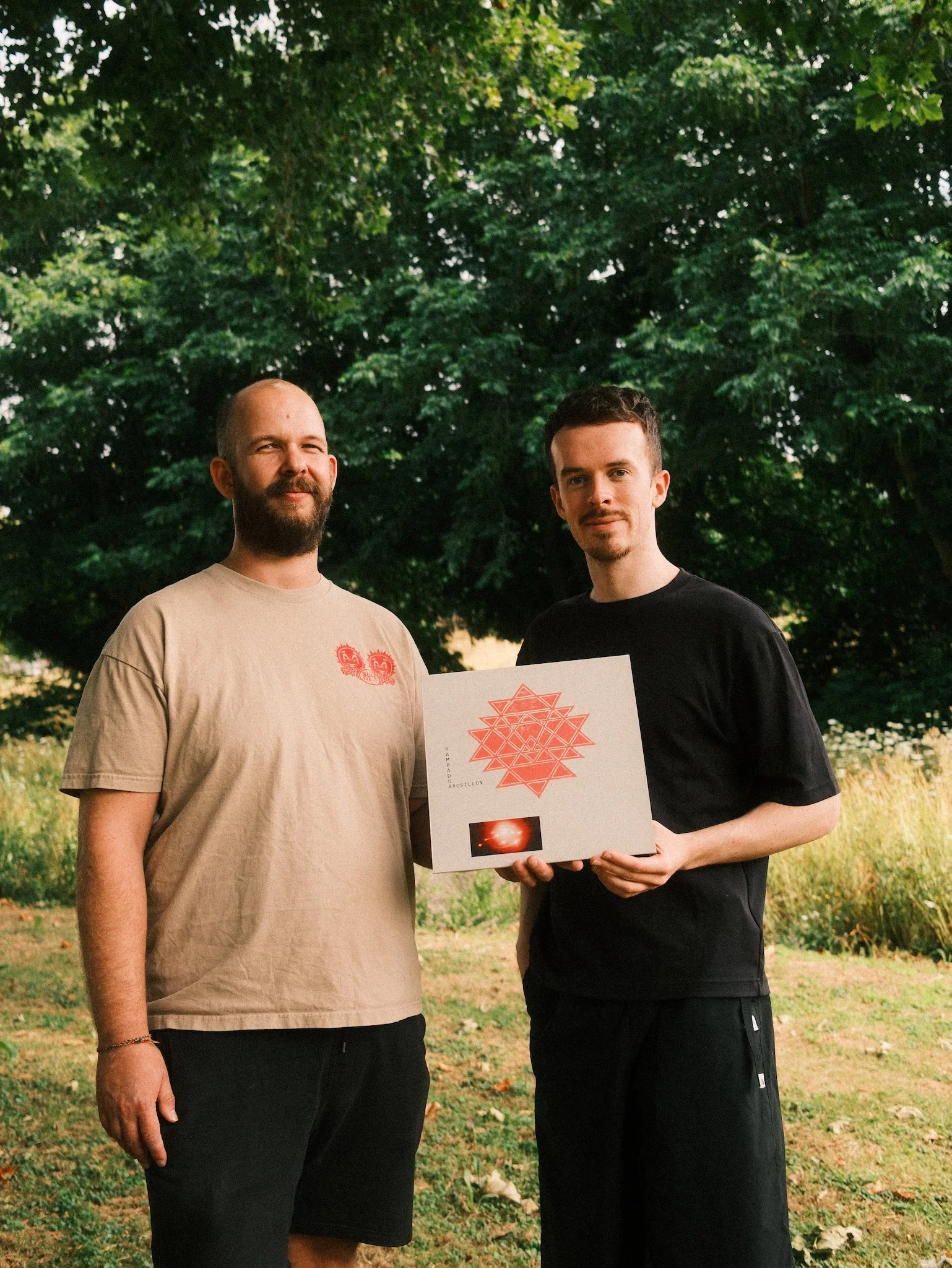
Rambadu & Rosillon
I barely asked you any questions, if you noticed. I just gave you a couple of starters, and you had the conversation with each other and that is what I really love to see. Even though you are telling me the story, it is the most authentic way to get to it, and to bring it to the people who care about this music.
“I like to play tracks I am working on live, because then I can hear it in a gig setting and compare it with other parts I already introduced, sometimes it works straight away or it shows me what still needs to be done to the track. I played the B track in Japan during the live set too, which was a good moment to gauge.” - Rambadu
Rambadu: “This also shows how natural the process is. Some of the questions you asked, I really had to think about, like, how did we actually do that? Because it happens kind of subconsciously, and you’re not really aware of the process until you start reflecting on it.” Reflections, right? I say with a smile and Rosillon continues:
Rosillon: ‘’The process itself was just so much fun because it became a series of little rituals. We'd always meet around ten or eleven in the morning, and whoever was visiting would bring croissants for lunch. Sometimes we'd spend an hour or more just catching up, talking about life before we even got to the music. That's what I meant about the friendship growing and deepening in such a meaningful way. We'd connected from the very beginning, but through this process we really got to know each other on a much deeper level. ‘’
Rambadu: “Something else that comes to mind now is that when I got in contact with Rosillon, I was really at a point where I was wondering am I the only one making this kind of music in Rotterdam? Not that there aren’t a lot of people I connect with about what I’m doing, and there are a lot of people I know and am friends with outside the Netherlands, which is nice, but they’re not in your own infrastructure. It’s very different to connect with people near you. It also opened the city up more for me, with the Embodiment guys too, they all feel like friends.”
It has been a few eventful and beautiful years working together, Paul for all of us. Now that you mentioned Embodiment you recently presented your live set with Joep at the first Embodiment ambient listening session. The collaboration between Rambadu, Rosillon and Embodiment has been going on since the start, in different shapes and forms and now that it is translating into a record, everything that was quietly building between these people has found its most tangible form yet. I hope this release also opens new doors of inspiration for you, Paul, with all the new sound directions you have started exploring and who knows, maybe it will bring other people doing similar things into your orbit, because that is how it works. You put something out into the world…
Rambadu: “And then sharing it and growing is about sharing with everyone, basically.” Absolutely I say. Speaking of sharing, α δ will be available both on vinyl and digital, even though we are in the presence of a vinyl-only DJ who might have preferred it to stay that way.
Rosillon: “No, I don’t believe every release should be vinyl only. I’m very happy when I find something at Clone that’s vinyl only, but for producing it’s different. At this point I can’t really imagine playing my own music. I don't yet know how I’d incorporate it, because the track is the track, and mixing it differently feels awkward. Changing my own music is very difficult.” Rosillon smiles somewhere between excitement and the particular nervousness of something you have worked towards for a long time finally becoming real.
Rambadu:“I like to play tracks live, because then I can hear it in a gig setting and compare it with other parts I already introduced, sometimes it works straight away or it shows me what still needs to be done to the track. I played the B track in Japan during the live set too, which was a good moment to gauge.”
Rosillon: “I saw someone actually post a story on Instagram of that exact moment. It was quite an exciting feeling to know people on the other side of the world were vibing to the music.”
What remains to be seen is how people around the world will find their own way into this record and what they will do with it. As of now, previews of all tracks are available in record stores worldwide and on Bandcamp. I hope you enjoyed getting to know these two artists and their world a little better through this conversation, and the track we had the honour of premiering today. Music made this way with this level of care, patience and genuine connection deserves to be heard, supported and played. Pre-order the record and support the artists.
On my side, there is nothing left to say but thank you to both artists for the time, the openness and the trust. Conversations like this inspire me significantly and remind me why I keep doing this and why I love this culture and music. I will continue to follow and support each of them on their artistic paths, and I am grateful that Nachtblumen gets to be part of the story.